For self-employed workers, a single accident doesn't just hurt physically — it can gut your finances. That's the gap accident insurance is designed to fill.
Accident insurance is a supplemental policy that pays scheduled cash benefits directly to you when you suffer a covered injury. It doesn't replace health insurance, but it bridges the income and out-of-pocket gap that health insurance leaves behind. This guide covers how it works, what it covers, how to build it into a broader coverage plan, and what to look for when comparing policies.
Key Takeaways
- Self-employed workers have no employer safety net — no paid sick leave, no workers' comp, no disability coverage by default
- Accident insurance pays cash benefits for covered injuries like fractures, ER visits, and hospitalization — money you control
- Accident insurance supplements your health insurance — it does not replace it
- Premiums are affordable, making it one of the more accessible protection layers for independent workers
- Compare benefit schedules, exclusions, and coverage triggers — not just the premium — when choosing a policy
Why Self-Employed Workers Have No Safety Net
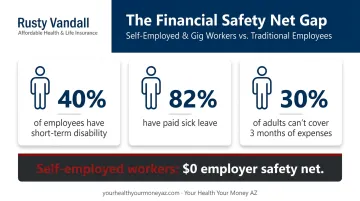
Most employees take workplace protections for granted. If they break an arm, workers' comp may apply. If they're recovering from surgery, short-term disability can replace a portion of their salary. BLS data from March 2025 shows the gap clearly:
- 40% of private industry workers have access to short-term disability plans
- 82% have paid sick leave
Self-employed workers — freelancers, independent contractors, sole proprietors, gig workers — get none of this automatically. As the Department of Labor makes clear, independent contractors are in business for themselves and fall outside standard employee protections. In most states, workers' compensation doesn't apply to solo self-employed individuals.
The numbers behind this workforce are substantial. According to the BLS, 11.9 million people worked as independent contractors on their primary job as of July 2023, representing 7.4% of total employment. Add unincorporated self-employed workers and the affected population grows further.
The Cash-Flow Reality
For a salaried employee, an injury means medical bills and some disruption. For a self-employed worker, it means all of that plus no income.
The Federal Reserve's 2024 survey found that 31% of gig workers would struggle to make ends meet without their gig income, and 30% of all adults couldn't cover three months of expenses by any means. A broken bone that sidelines you for six weeks isn't just a medical problem — it's a cash-flow crisis.
Accident risk also isn't limited to tradespeople and construction workers. The NSC estimated 45.8 million medically consulted home and community injuries in 2024. A car accident, sports injury, or fall at home can cut off your income just as fast as a workplace incident — whatever your line of work.
What Accident Insurance Actually Covers
When you're self-employed, a broken wrist isn't just a medical problem — it's a cash flow problem. Accident insurance exists to address exactly that. The NAIC defines it as coverage for death, dismemberment, disability, or hospital and medical care caused by an accident, and the Oklahoma Department of Insurance is explicit: these are limited-benefit plans designed to supplement comprehensive health coverage, not replace it.
Accident insurance pays you directly according to a fixed benefit schedule. It doesn't bill your doctor or settle claims with a hospital — you receive cash and decide how to use it.
Typical Covered Benefits
Based on policy materials from major carriers including Aflac and UnitedHealthcare, common benefit categories include:
- Fractures and dislocations, including broken bones and joint injuries
- Lacerations that require stitches or surgical closure
- Burns above a minimum severity threshold (policy-specific)
- Emergency room visits and ambulance transport
- Hospital admission and confinement
- Follow-up care and physical therapy after a covered accident
- Accidental death or dismemberment (AD&D)
Each benefit has a fixed dollar amount tied to it. A fractured wrist pays a specific amount; a femur fracture pays more. You're not reimbursed for actual costs — you receive a scheduled payment regardless of what your treatment cost.
Common Exclusions to Review Carefully
Policies don't cover everything. Documented exclusions across major carriers typically include:
- Injuries while intoxicated or under the influence of drugs (unless physician-directed)
- Injuries resulting from criminal or felony activity
- Hazardous or extreme sports activities
- Injuries caused by sickness, disease, or pre-existing bodily conditions
Read the actual state-specific policy form before enrolling. Exclusions vary by carrier and state, and an assumption that any injury is covered can lead to a denied claim.
Accident Insurance vs. Disability Insurance
These two products are frequently confused, but they serve distinct purposes:
| Feature | Accident Insurance | Disability Insurance |
|---|---|---|
| Trigger | Specific covered accident | Inability to work (accident or illness) |
| Benefit type | One-time or scheduled cash payment | Monthly income replacement |
| Duration | Per covered event | Weeks, months, or years |
| Scope | Injury-specific | Broader — includes illness |
For self-employed workers, these products address different financial risks. Accident insurance covers the immediate cash crunch from a covered injury; disability insurance addresses longer-term income loss from any condition — accident or illness — that keeps you from working.
Building a Layered Coverage Strategy
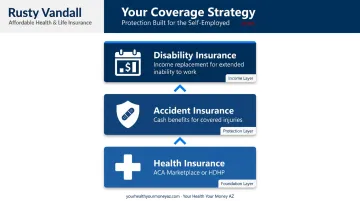
No single policy covers everything. For self-employed workers, a practical coverage stack looks like this:
- Health insurance (ACA Marketplace or HDHP) — covers medical treatment costs, subject to deductibles and cost-sharing
- Accident insurance — pays scheduled cash benefits for covered injuries, helping offset deductibles and lost income
- Disability insurance — replaces income when any illness or injury prevents you from working for an extended period
The HDHP Pairing
Many self-employed workers choose high-deductible health plans to keep monthly premiums manageable. The tradeoff works fine right up until you need to use your coverage. The KFF 2025 Employer Health Benefits Survey found an average annual deductible of $1,886 for single coverage among workers in plans with a general deductible. IRS rules define 2025 HDHPs as requiring at least a $1,650 self-only deductible.
That's real out-of-pocket exposure at the moment you're least able to absorb it. The cash benefit from an accident policy can cover that deductible gap, medical copays, or even basic living expenses while you recover.
Marketplace Coverage and Self-Employment
The ACA Marketplace is the primary health coverage source for a large share of self-employed workers. A 2024 Treasury Department analysis found that 18% of self-employed workers and small business owners ages 21–64 had Marketplace coverage in 2022, compared to just 6% of the rest of the working population in that age range.
Layering accident insurance on top of an ACA plan is a straightforward way to fill the gap: the ACA plan handles your medical bills, while the accident policy covers the out-of-pocket costs your health plan leaves behind.
How to Choose the Right Accident Insurance Policy
Comparing accident policies requires looking past the premium. Here's what actually matters:
Key Features to Evaluate
- Schedule of benefits — what specific injuries are covered and at what dollar amounts. Compare ER, ambulance, fracture, dislocation, hospital, and AD&D benefit amounts across carriers
- Covered accident definition — some policies require the injury to be sudden, unexpected, and treated within a specific time window. Understand exactly what qualifies
- Exclusion list — review every exclusion in the state-specific form, not just the marketing summary
- Benefit conditions — accident policies often have treatment deadlines or confinement requirements tied to specific benefits. These are different from disability-insurance elimination periods
- Renewability — verify whether the policy is guaranteed renewable in your state
Assess Your Personal Risk Profile
Before comparing plans, answer these questions honestly:
- What's your health insurance deductible? A higher deductible increases your need for a cash buffer
- How much emergency savings do you have? If you have three months of expenses saved, your urgency is different than if you have three weeks
- How long could your business operate without you? Some self-employed workers have recurring clients; others lose everything the moment they stop delivering
- What are your hobbies and lifestyle? If you ski, cycle seriously, or participate in contact sports, check exclusions carefully

Work With an Independent Agent
Benefit schedules, exclusions, and pricing vary significantly between carriers, and those differences aren't obvious from a summary page. An independent agent can compare multiple carriers side-by-side and evaluate accident coverage alongside your ACA health plan, disability coverage, and other supplemental needs.
Rusty Vandall at Your Health Your Money AZ, for example, works with self-employed clients across Arizona and multiple states — comparing accident plans, ACA Marketplace coverage, and other supplemental products from a range of carriers to find what fits your actual situation. You can reach him directly at 602-291-5169 for a no-cost consultation.
Frequently Asked Questions
What insurance do I need if I'm self-employed?
At minimum, self-employed workers need health insurance — typically through the ACA Marketplace. Beyond that, accident insurance, disability insurance, and any relevant business liability coverage fill the gaps that employer benefits normally would.
Is it worth getting personal accident cover?
For most self-employed workers, yes. Even a relatively minor injury can stop your income entirely, and accident insurance premiums are typically modest relative to the cash protection they provide. The cost-to-protection ratio makes it a sensible addition to any self-employed coverage plan.
What does accident insurance cover for self-employed workers?
Accident insurance pays scheduled cash benefits for covered injuries — fractures, dislocations, burns, ER visits, ambulance transport, and hospitalization, among others. Benefits are paid directly to you and can be used for anything: medical bills, business overhead, or day-to-day living expenses.
How is accident insurance different from disability insurance?
Accident insurance pays a fixed, scheduled benefit for a specific covered injury event. Disability insurance pays a monthly income replacement benefit for an extended inability to work, covering both accidents and illness. Both serve distinct roles; one isn't a substitute for the other.
Can I deduct accident insurance premiums if I'm self-employed?
Self-employed health insurance premiums qualify for a 100% deduction, but supplemental accident insurance is treated differently — IRS Publication 502 excludes premiums for policies covering loss of earnings or loss of life, limb, or sight. Tax treatment varies by policy structure, so consult a tax advisor for your situation.
Does accident insurance cover injuries that happen outside of work?
Personal accident insurance generally covers injuries anywhere — at home, during recreation, or commuting — not just on the job. Exclusions for extreme sports, intoxication, or criminal activity still apply, so review your specific policy form.