
Introduction
When you start a salaried job, retirement savings often happen automatically — your employer enrolls you, sets up payroll deductions, and sometimes matches your contributions. When you're self-employed, none of that exists. You're responsible for every decision, every deadline, and every dollar.
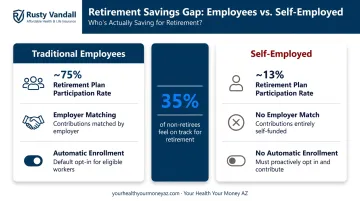
That friction causes real delays. According to Pew Research, only about 13% of self-employed workers in single-person firms reported participating in retirement plans at their current jobs — compared to nearly three-quarters of traditional employees.
The good news: self-employed individuals can access retirement accounts with contribution limits that often exceed what traditional employees can put away. The five plans covered in this guide — SEP IRA, Solo 401(k), SIMPLE IRA, Traditional IRA, and Roth IRA — each offer distinct tax advantages suited to different income levels, business structures, and savings goals. By the end, you'll know which account — or combination — fits your situation.
Key Takeaways
- SEP IRAs and Solo 401(k)s offer the highest contribution limits — up to $72,000 in 2026 — making them ideal for maximizing tax-deferred savings
- SIMPLE IRAs suit self-employed individuals who have or plan to hire employees
- Traditional IRAs reduce your tax bill now; Roth IRAs build tax-free income for retirement — both work well as supplements
- You can contribute to multiple plans in the same year (for example, a SEP IRA and a Roth IRA)
- Starting early matters more than the account type you choose, even in low-income years
Why Retirement Planning Looks Different When You're Self-Employed
There's no employer to set up the account, no payroll deduction running quietly in the background, and no HR email reminding you to increase your contribution rate. Every step falls on you: choosing the plan, opening the account, calculating your contribution, and funding it before the deadline. That administrative gap creates real consequences across three areas:
- Tax burden: Self-employed workers pay self-employment tax at 15.3% — both the employee and employer portions of Social Security and Medicare. Salaried employees only see 7.65% withheld. Tax-advantaged retirement accounts directly reduce your net self-employment income, easing that load.
- No automatic enrollment: Without employer-sponsored plans, nothing gets contributed unless you actively open and fund an account.
- No contribution matching: Every dollar saved comes entirely from your own pocket, with no employer match to accelerate growth.
The retirement savings gap is measurable. The Federal Reserve's 2025 household survey found that only 35% of non-retirees believe their retirement savings are on track — and that's across all workers. For self-employed individuals without automatic enrollment, the gap tends to be wider.
The 11.9 million independent contractors currently working in the U.S. are largely building their retirement savings without institutional support. The five account types below are designed for exactly that situation — each with different contribution limits, tax treatments, and administrative requirements worth understanding before you choose.
5 Self-Employed Retirement Account Options
These five account types are the most widely used and accessible options for self-employed individuals and independent contractors, each suited to different income levels, business structures, and savings goals.
SEP IRA (Simplified Employee Pension IRA)
A SEP IRA is designed for self-employed individuals and small business owners of any size. Contributions go directly into a traditional IRA for each eligible employee — funded entirely by the employer, not the worker. There's no annual IRS filing required, which keeps administration minimal.
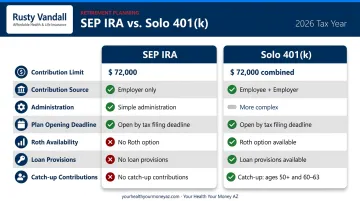
The real appeal is the contribution ceiling and timing flexibility. You can open a SEP IRA as late as your tax filing deadline, including extensions, for the prior year — making it a legitimate last-minute tax reduction tool.
| 2026 Contribution Limit | Lesser of 25% of net self-employment earnings or $72,000 |
| Tax Treatment | Pre-tax contributions; tax-deferred growth; withdrawals taxed as ordinary income |
| Best Suited For | Sole proprietors, freelancers, and small business owners with no or few employees who want high limits and simple administration |
Solo 401(k) (One-Participant 401(k))
The Solo 401(k) is built exclusively for self-employed individuals with no employees other than a spouse. Unlike a SEP IRA, you contribute as both the employee (salary deferral up to $24,500 in 2026) and the employer (profit-sharing contributions). Both roles combine toward the same $72,000 ceiling.
At lower income levels, this dual structure lets you contribute a higher percentage of earnings than a SEP IRA would allow — a meaningful advantage in variable-income years.
Additional features set it apart:
- Roth option — designate some or all deferrals as after-tax Roth contributions
- Loan provisions — many plans allow participant loans (not available with SEP IRAs)
- Catch-up contributions — $8,000 additional for those 50+; $11,250 for ages 60–63
One timing note: the Solo 401(k) must generally be established by December 31 of the plan year, though sole proprietors with no employees may adopt one by their tax filing deadline for 2023 and later years.
| 2026 Contribution Limit | Up to $72,000 combined; $80,000 with age 50+ catch-up |
| Tax Treatment | Traditional (pre-tax) or Roth (after-tax) options available |
| Best Suited For | Self-employed individuals with no employees who want maximum flexibility and a Roth option |
SIMPLE IRA
The SIMPLE IRA is available to businesses with 100 or fewer employees. Unlike the SEP IRA and Solo 401(k), it involves contributions from both the employer and employee — making it one of the only self-employed plans with mandatory annual employer contributions.
Employers choose between two contribution structures:
- Dollar-for-dollar match up to 3% of compensation
- Flat 2% nonelective contribution for each eligible employee
The tradeoff: lower contribution limits and a steeper early withdrawal penalty. Withdrawals within the first two years of participation carry a 25% penalty (not the standard 10%), which makes SIMPLE IRAs poorly suited for those with unstable income who might need early access to funds.
| 2026 Contribution Limit | $17,000 employee deferrals; $4,000 catch-up for ages 50+; $5,250 for ages 60–63 |
| Tax Treatment | Pre-tax; tax-deferred growth; withdrawals taxed as ordinary income; 25% early withdrawal penalty in first two years |
| Best Suited For | Self-employed individuals who have or plan to hire employees and want an easy-to-administer plan with mandatory employer contributions |
Traditional IRA
The Traditional IRA is the most accessible starting point — any individual with earned income can open one. Contributions may be fully or partially tax-deductible depending on income, and it pairs naturally with higher-limit plans like a SEP IRA.
The deductibility phases out for 2026 if you're covered by a workplace plan: $81,000–$91,000 for single filers and $129,000–$149,000 for married filing jointly. Self-employed individuals contributing to a SEP IRA or Solo 401(k) are considered to have a workplace plan.
| 2026 Contribution Limit | $7,500 (under 50); $8,600 with catch-up for those 50+ |
| Tax Treatment | Contributions may be deductible; tax-deferred growth; withdrawals taxed as ordinary income; RMDs required at age 73 |
| Best Suited For | Those just starting out, lower-income earners, or anyone supplementing a primary high-limit plan |
Roth IRA
The Roth IRA flips the tax equation. You contribute after-tax dollars now — no upfront deduction — but qualified withdrawals in retirement, including all growth, are completely tax-free. There are no required minimum distributions during your lifetime, giving you more control over when and how you draw down assets.
The catch is income eligibility. Roth IRA contributions phase out in 2026 for single filers earning $153,000–$168,000 and married filers earning $242,000–$252,000. High-income self-employed individuals above those thresholds can explore a backdoor Roth strategy — making nondeductible Traditional IRA contributions and then converting to Roth — which is recognized under IRS Form 8606 reporting rules.
| 2026 Contribution Limit | $7,500 (under 50); $8,600 with catch-up for those 50+; subject to income phase-out limits |
| Tax Treatment | After-tax contributions; tax-free growth; qualified withdrawals tax-free; no RMDs required |
| Best Suited For | Those expecting a higher tax rate in retirement, younger earners, or anyone wanting tax diversification alongside a pre-tax plan |
How to Choose the Right Retirement Plan for Your Situation
No single plan works for everyone. Four variables should drive your decision:
- Current and expected future income — higher earnings favor SEP IRA or Solo 401(k)
- Whether you have or plan to hire employees — employees change the math significantly
- Primary goal — maximizing contributions vs. minimizing administrative complexity
- Tax bracket timing — whether you want deductions now or tax-free income later
A Practical Decision Path
| Your Situation | Best Starting Point |
|---|---|
| Solo, high or variable income, no employees | SEP IRA or Solo 401(k) |
| Want Roth option + loan flexibility | Solo 401(k) |
| Have or plan to hire employees | SIMPLE IRA |
| Just starting out or lower-income year | Traditional or Roth IRA |
| Want to maximize tax diversification | High-limit plan + Roth IRA |
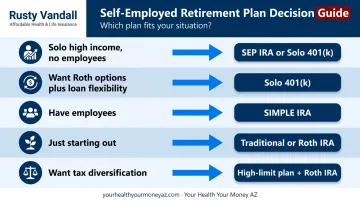
Most self-employed individuals benefit from combining a high-limit plan with a Roth IRA — this spreads contributions across pre-tax and after-tax buckets, giving you flexibility to manage your tax exposure in retirement.
Common Mistakes to Avoid
- Don't wait for a "good year" to start — every year you delay forfeits compounding growth
- Don't choose by ease of setup alone — the simplest plan isn't always the right fit for your income level
- Miscalculating net earnings is a common trap: SEP IRA and Solo 401(k) contributions are based on net self-employment income after the self-employment tax deduction, not gross revenue
These decisions get complicated fast — especially when income varies year to year. Rusty Vandall at Your Health Your Money AZ works with self-employed individuals and small business owners across Arizona to map out plan options based on their specific income and goals. As an independent agent, he compares multiple plan structures without being limited to one provider's lineup. Reach him at 602-291-5169 for a no-cost consultation.
Can You Contribute to More Than One Plan?
Yes — self-employed individuals can contribute to multiple retirement accounts in the same tax year. A common and effective combination is a SEP IRA or Solo 401(k) paired with a Traditional or Roth IRA. Each account type has its own contribution limit, and you must stay within those limits individually. However, contributing to a SEP IRA or Solo 401(k) may reduce or eliminate the deductibility of Traditional IRA contributions depending on your income.
The HSA as a Supplemental Vehicle
Self-employed individuals enrolled in a high-deductible health plan (HDHP) can also contribute to a Health Savings Account (HSA) — technically not a retirement account, but relevant here because of its triple tax advantage and post-65 flexibility. HSAs offer triple tax advantages: deductible contributions, tax-free growth, and tax-free withdrawals for qualified medical expenses. In 2026, contribution limits are $4,400 for self-only coverage and $8,750 for family coverage.
After age 65, HSA funds can be withdrawn for any purpose (taxed as ordinary income, like a Traditional IRA), making the HSA a useful backup savings account beyond just medical costs. Since self-employed individuals also manage their own health coverage, pairing an HDHP with an HSA is often a practical pairing that covers both coverage costs and tax-advantaged savings in one move. For self-employed individuals, whether an HDHP makes financial sense depends on your health usage and premium tradeoffs — worth evaluating alongside your broader retirement strategy, ideally with an independent agent who handles both health and retirement planning.
Conclusion
Being self-employed removes the automatic safety net. It also unlocks retirement accounts with higher contribution limits and stronger tax advantages than most W-2 employees ever see. The key is choosing the right plan for your income level and business structure — and starting before conditions feel perfect, because they rarely do.
If you're a self-employed individual in Arizona or elsewhere and want to compare your options with a licensed professional who works with multiple carriers and solutions, Rusty Vandall at Your Health Your Money AZ offers personalized retirement planning consultations at no cost. Call 602-291-5169 to talk through which accounts make the most sense for your situation.
Frequently Asked Questions
What is the best retirement plan for an independent contractor?
It depends on your income and whether you have employees. Solo 401(k)s and SEP IRAs offer the highest contribution limits for solo operators — up to $72,000 in 2026. Most contractors benefit from pairing one of those high-limit plans with a Roth IRA for tax diversification.
How do independent contractors retire?
Independent contractors retire by building savings through self-directed accounts — SEP IRAs, Solo 401(k)s, and IRAs — alongside Social Security based on self-employment taxes paid over time. Without an employer plan, disciplined contributions to these accounts are the primary retirement strategy.
What is the $400 rule for self-employed people?
Net self-employment earnings of $400 or more trigger a federal filing requirement and self-employment tax — currently 15.3% (Social Security 12.4%, Medicare 2.9%). That tax applies to 92.35% of net earnings, not your total gross amount.
Can self-employed individuals contribute to more than one retirement plan at the same time?
Yes. A common combination is a SEP IRA or Solo 401(k) paired with a Roth IRA, as long as each account's contribution limits are respected independently. Income eligibility requirements — particularly for the Roth IRA — still apply.
When is the deadline to open and fund a self-employed retirement plan?
Deadlines vary: SEP IRAs can be funded up to your tax filing deadline (plus extensions); Solo 401(k)s must generally be established by December 31; and Traditional or Roth IRA contributions are due by April 15 of the following year.
What happens to my retirement plan if my self-employment income drops significantly?
Most plans handle lean years well — SEP IRA and Solo 401(k) contributions are discretionary and scale with income, and IRAs can go unfunded without penalty. The exception is the SIMPLE IRA, which requires employer contributions regardless of income.