The good news: unemployment doesn't automatically mean going without coverage. Most people have more options than they realize, ranging from free government programs to subsidized Marketplace plans to temporary stopgap coverage. The right choice depends on your income, health needs, and how quickly you need coverage to start.
This guide breaks down every realistic option, what each one costs, and how to decide which fits your situation.
Key Takeaways
- Losing job-based insurance triggers a 60-day Special Enrollment Period to enroll in a new plan
- ACA Marketplace plans offer comprehensive coverage, and most unemployed individuals qualify for premium subsidies
- Medicaid is free or near-free if income has dropped sharply — and accepts applications year-round
- COBRA keeps your existing doctors but is far more expensive — you cover the full premium yourself
- Short-term plans fill immediate gaps but exclude pre-existing conditions and essential benefits
Health Insurance Options When You're Unemployed
Five main pathways exist for unemployed individuals. Each has different eligibility requirements, cost structures, and coverage depth — no single option fits everyone.
COBRA Continuation Coverage
COBRA (Consolidated Omnibus Budget Reconciliation Act) lets workers at companies with 20 or more employees continue their employer's group health plan after leaving a job — typically for up to 18 months, or up to 36 months in certain situations like divorce or a dependent aging out of coverage.
The biggest drawback is cost. Without an employer sharing the premium, you pay the full amount plus up to a 2% administrative fee. Using KFF's 2025 average employer-sponsored premiums as a benchmark, that works out to roughly:
- ~$793/month for individual coverage
- ~$2,294/month for family coverage
The main reason to choose COBRA despite the cost: continuity. Your doctors, specialists, and prescriptions stay in-network with no disruption — which matters a lot if you're mid-treatment or managing an ongoing condition.
Important deadline: You have exactly 60 days from coverage loss to elect COBRA. Miss that window and the option disappears entirely.
ACA Marketplace Plans
Marketplace plans are the most broadly applicable option for most unemployed individuals. Job loss qualifies as a Special Enrollment Period, giving you 60 days from the date your coverage ends to enroll.
Every Marketplace plan covers all 10 essential health benefits — preventive care, emergency services, mental health, prescriptions, maternity care, and more. Crucially, no plan can deny you or charge more based on pre-existing conditions.
The financial case for Marketplace plans is strong. According to CMS's 2025 Open Enrollment Report:
- 92% of enrollees had premiums reduced by advance premium tax credits
- Average premium dropped from $619/month to $113/month after subsidies
- 42% of consumers paid $10 or less per month after tax credits
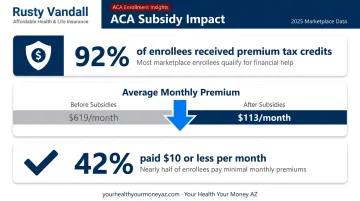
Subsidies are calculated based on your projected household income for the year — not last year's earnings. A significant income drop during unemployment can dramatically reduce what you pay each month.
An independent insurance agent — one who works with multiple carriers rather than a single insurer — can compare Marketplace plans side-by-side at no additional cost to you. Rusty Vandall at Your Health Your Money AZ does exactly this, helping clients identify which plan fits both their short and long-term needs across major carriers in Arizona and beyond.
Medicaid and CHIP
Medicaid provides free or very low-cost coverage to individuals and families below certain income thresholds. In states that expanded Medicaid under the ACA (41 states including DC and Arizona), adults qualify with incomes up to 138% of the Federal Poverty Level.
2025 income thresholds for Medicaid eligibility in expansion states:
| Household Size | 100% FPL | 138% FPL (Medicaid limit) |
|---|---|---|
| 1 person | $15,650 | $21,597 |
| 2 people | $21,150 | $29,187 |
| 4 people | $32,150 | $44,367 |
Source: HHS 2025 Poverty Guidelines
A key advantage: Medicaid accepts applications year-round, so you're not constrained by enrollment periods. If your income has dropped close to zero, check Medicaid eligibility before anything else.
CHIP covers children in households that earn too much for Medicaid but can't afford private coverage. Both programs are accessible through healthcare.gov or your state's Medicaid office.
Catastrophic Health Plans
Catastrophic plans are available to individuals under 30, or those who qualify for a hardship or affordability exemption — which can include circumstances like job loss, eviction, or bankruptcy.
These plans carry low monthly premiums but very high deductibles ($10,600 for an individual in 2026). They're designed for worst-case protection only — not ongoing care management.
One critical limitation: catastrophic plans don't qualify for premium tax credits. If you're eligible for Marketplace subsidies, a subsidized Silver or Bronze plan will almost always cost less out of pocket than a catastrophic plan.
Joining a Spouse's or Family Member's Plan
If your spouse or domestic partner has employer-sponsored coverage, losing your job-based insurance is a qualifying life event — their employer plan must open a Special Enrollment Period to add you. Note the timeline: HIPAA gives you only 30 days to enroll through a job-based plan — half the window you get through the Marketplace — so act quickly.
Before enrolling, compare your share of the premium on the spouse's plan against what a subsidized Marketplace plan would cost. When the employer contributes significantly to the premium, the spouse's plan is often the most affordable route available.
Short-Term Health Insurance: What Unemployed Individuals Must Know
Short-term health insurance is a temporary, non-ACA-compliant product designed to fill brief coverage gaps. It can take effect as quickly as the next day and is available year-round — no enrollment window required. That convenience, however, comes at a cost worth understanding before you sign up.
What Short-Term Plans Don't Cover
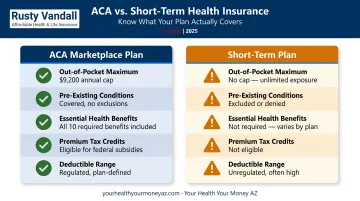
Short-term plans are exempt from ACA requirements, meaning they can legally:
- Exclude pre-existing conditions entirely
- Skip essential health benefits (mental health, maternity care, prescriptions)
- Cap total benefits paid
- Use medical underwriting to set premiums
Post-claims underwriting is the riskiest feature of short-term plans. Insurers review your full medical history after you file a claim, then deny it (or rescind the policy) if they determine the condition predated coverage. You can pay premiums for months and only find out you're not covered when you actually need care.
Cost and Coverage Reality
Short-term premiums can be lower than unsubsidized ACA plans because the coverage is thinner; insurers can exclude high-cost risks. Even so, deductibles on short-term plans can reach $5,000–$10,000 or more, and there's no ACA-mandated out-of-pocket maximum. ACA-compliant plans cap individual out-of-pocket costs at $9,200 in 2025; short-term plans face no such limit.
Currently, short-term plans are available in approximately 36 states. States like California, New York, New Jersey, and Massachusetts ban or heavily restrict them. Check KFF's state-by-state analysis for current availability.
Note: Federal rules governing short-term plan duration have been in flux — as of August 2025, the relevant agencies stated their intent to reconsider the 2024 rules limiting plans to 3–4 months. Confirm current federal and state rules before enrolling.
When Short-Term Plans Make Sense — and When They Don't
Consider a short-term plan if:
- You're young and healthy with no chronic conditions
- You expect to start a new job with employer coverage within weeks
- You're in a state where they're available and you can't qualify for subsidies
Avoid short-term plans if:
- You have any pre-existing conditions
- You qualify for Marketplace subsidies (an ACA plan will likely cost less net)
- You need maternity care, mental health services, or prescription coverage
- You're in a state where they're banned or heavily restricted
How to Choose the Right Health Insurance Option When Unemployed
The income-based decision tree is the most practical starting point.
Step 1: Check Your Income Against Program Thresholds
- Near-zero or below Medicaid limits: Apply for Medicaid immediately. It's free or near-free and available year-round.
- Above Medicaid limits, below ~400% FPL: ACA Marketplace plans with subsidies are almost always the best value. At 150% FPL or below, you may qualify for a continuous SEP to enroll or change plans at any time.
- Above 400% FPL: Compare COBRA against unsubsidized Marketplace plans based on premium, network, and deductible.
Use healthcare.gov to estimate your subsidy eligibility based on projected income — not last year's figure.
Step 2: Factor in Timing
- Job loss early in the year: Select a plan built to last the full year; switching mid-year creates administrative complexity.
- Job loss in fall: Weigh whether to start a Marketplace plan now or bridge with short-term coverage through December 31, then enroll in an Open Enrollment plan starting January 1. Run the numbers first. The bridge option only makes sense if you're healthy and the short-term premium plus potential cost exposure beats a subsidized plan.
- New employer start date coming up: If you're starting a job in 30–60 days, a very short gap might be bridged differently than an open-ended unemployment period.
Step 3: Compare Total Cost, Not Just Premium
Monthly premium is one line item. Focusing only on it is one of the most common and expensive mistakes people make. Also compare:
- Deductible — what you pay before insurance kicks in
- Out-of-pocket maximum — your worst-case annual exposure
- Copays and coinsurance — your share of costs after the deductible
- Network — whether your existing doctors and specialists are in-plan
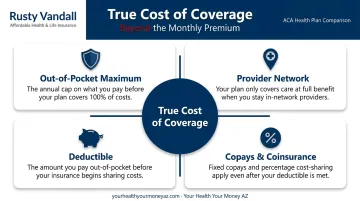
A $200/month plan with a $8,000 deductible and a narrow network can cost far more than a $350/month plan with a $2,000 deductible if you actually use healthcare.
These comparisons get complicated fast. Rusty Vandall at Your Health Your Money AZ walks through this side-by-side across multiple carriers at no charge, helping you avoid optimizing for the wrong number.
Conclusion
Unemployment opens a stressful window, but it doesn't have to mean going without coverage. The 60-day Special Enrollment Period is your most important deadline — once it closes, your options narrow significantly until the next Open Enrollment.
The priority order is simple: check Medicaid first if income has dropped sharply, evaluate subsidized Marketplace plans if you're above the Medicaid threshold, and only consider COBRA or short-term plans after running those comparisons.
Navigating these options alone is harder than it needs to be. Rusty Vandall at Your Health Your Money AZ provides no-cost, personalized guidance for individuals and families working through this transition. As an independent agent with access to major carriers across Arizona and multiple states, he can compare plans side-by-side and help you find coverage that fits your current circumstances and budget.
Reach him directly at 602-291-5169.
Frequently Asked Questions
What is the best short-term health insurance for unemployed people?
The right option depends on your age, state, health status, and how long you need coverage. Short-term plans vary widely in what they cover and exclude, and should only be considered by those who are young, healthy, and ineligible for subsidized Marketplace coverage.
How much does short-term health insurance cost when you're unemployed?
Premiums vary by age, state, and coverage level. While some plans start under $100/month, they often carry deductibles of $5,000–$10,000 or more and no ACA-mandated cap on out-of-pocket costs — meaning your actual financial risk can be far higher than the premium alone implies.
Are pre-existing conditions covered by short-term health insurance?
Generally, no. Short-term plans use medical underwriting and can deny claims through post-claims underwriting — reviewing your history after you file and denying coverage if the condition predated enrollment. Anyone with chronic conditions should use ACA Marketplace plans instead.
Does losing your job qualify you for a Special Enrollment Period?
Yes. Losing job-based health insurance is a qualifying life event that triggers a 60-day Special Enrollment Period, giving you the ability to enroll in a Marketplace plan or other qualifying coverage outside of Open Enrollment.
How long do you have to enroll in a new health plan after losing your job?
You generally have 60 days from the date your job-based coverage ends to enroll in a Marketplace plan. Missing this window means waiting until the next Open Enrollment Period (typically November through January) unless another qualifying event occurs.
Can I get health insurance if I'm unemployed with no income?
Yes. Individuals with very low or no income may qualify for Medicaid, which provides free or near-free coverage and accepts applications year-round. In states that haven't expanded Medicaid, some low-income adults may fall into a coverage gap — in that case, federally funded health centers offer sliding-scale care as a supplemental resource.