
This guide covers everything you need: eligibility requirements, the five-step licensing process, costs, renewal rules, and what to do after you have your license in hand.
Whether you're changing careers, just graduated, or already work in financial services and want to add life insurance to your credentials — this is your starting point.
Key Takeaways
- Pre-licensing education is optional in Arizona, but strongly recommended for exam success
- Total regulatory costs run approximately $200–$210 (exam, fingerprinting, and application fees)
- You must score 70% or higher to pass the PSI licensing exam
- Licenses renew every 4 years with 48 CE hours required, including 6 hours of ethics
- Getting licensed is only part of the process — a carrier appointment is also required before you can legally sell policies
Arizona Life Insurance Agent Requirements: Who Qualifies?
Basic Eligibility
DIFI's licensing page sets a short list of requirements for resident applicants:
- Must be at least 18 years old
- Must be an Arizona resident or have a principal place of business in the state
- Must submit evidence of lawful presence if you don't already hold an active Arizona insurance license
Background Check and Fingerprinting
Arizona requires electronic fingerprinting for all first-time resident applicants. DIFI checks submissions against both Arizona and FBI criminal history databases. Key things to know:
- Felony convictions for dishonesty or breach of trust are the most common disqualifying factor
- Minor infractions typically don't prevent licensure
- Any felony conviction requires careful review and may need a written consent waiver
Nonresident Applicants
If you're already licensed in another state, Arizona offers a nonresident license path. You must be licensed and in good standing in your home state for the lines you're requesting. Check the current NIPR Arizona nonresident page for the latest reciprocity requirements before applying.
Once you've confirmed you meet the eligibility requirements, the next step is completing your prelicensing education.
How to Get Your Arizona Life Insurance License: Step-by-Step
Most candidates complete the entire process in four to six weeks, though DIFI notes that fingerprint results from DPS and the FBI can take up to 90 days, so submitting fingerprints early is smart.
Step 1: Complete a Pre-Licensing Course (Recommended, Not Required)
Arizona doesn't mandate any pre-licensing education hours, which distinguishes it from most states. But skipping preparation entirely is a risk. A quality prep course covers the material that directly maps to the exam:
- Insurance fundamentals and policy types (term, whole, universal life)
- Arizona-specific insurance laws under the Arizona Revised Statutes (ARS)
- Ethics and agent regulations
- Annuities and federal tax considerations
Providers like Kaplan Financial and XCEL Solutions offer Arizona life and health exam prep packages. Pricing generally runs $139–$349 depending on the package and format.
Step 2: Schedule and Pass the Arizona Life Insurance Exam
Arizona life insurance exams are administered by PSI Services (previously Prometric). Two exam options apply to life insurance:
| Exam | Code | Questions | Time Limit |
|---|---|---|---|
| Life Insurance Producer | Series 13-31 | See current PSI portal | ~2 hours |
| Life, Accident & Health | Series 13-33 | 150 questions | 2.5 hours |
The passing score is 70% for all Arizona insurance exams. The exam fee listed in the official Arizona licensing bulletin is approximately $53 per attempt; verify the current amount in the PSI scheduling portal before registering, as fees can change.
Exam logistics:
- Bring a government-issued photo ID with signature; a second signature ID is also required
- Results appear on screen immediately as pass or fail
- DIFI limits candidates to 4 attempts within any one-year period
Step 3: Submit Your Electronic Fingerprints
Arizona uses a two-part electronic fingerprint process:
- AZDPS Public Services Portal — submit your fingerprint request using insurance code INS-055.A
- Fieldprint — schedule your fingerprint appointment at fieldprintarizona.com
Total fingerprinting cost: $22.44 (AZDPS) + $8.25 (Fieldprint) = $30.69
Submit fingerprints before or at the same time you apply for your license. DIFI uses the results to run criminal history checks, and processing can take up to 90 days.
Step 4: Apply for Your Arizona Insurance License
Applications are submitted through the National Insurance Producer Registry (NIPR). The application fee is $120 (state fee; NIPR transaction fees may apply separately).
Your application will require:
- Confirmation that you've passed the exam
- Proof of fingerprint submission
- Personal background disclosures
- Selection of the correct license type: Resident Life Insurance Producer
DIFI requires you to apply within one year of passing the exam. Once approved, you'll receive a link to download or print your license.
Step 5: Get Appointed by an Insurance Carrier
A license alone doesn't authorize you to sell. Under Arizona Revised Statutes §20-289, a licensed insurance producer must also be formally appointed by each insurer they represent before writing business for that carrier.
Two main paths for new agents:
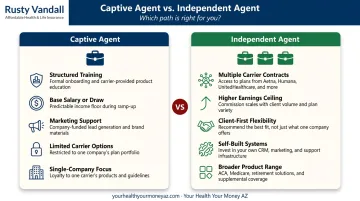
- Captive agent: contracted with one carrier exclusively. Typically includes structured training, a salary or draw against commissions, and closer support for newer agents.
- Independent agent: contracted with multiple carriers. Requires more self-direction, but gives clients broader options and generally leads to higher long-term earnings.
Most new agents get their first appointments through an established agency, an Independent Marketing Organization (IMO), or by contracting directly with carriers. Rusty Vandall of Your Health Your Money AZ took the independent route, building appointments across carriers like Aetna, Humana, UnitedHealthcare, Banner Life, Cigna, and others, which allows him to offer clients genuine side-by-side comparisons tailored to their specific needs.
How Much Does It Cost to Get a Life Insurance License in Arizona?
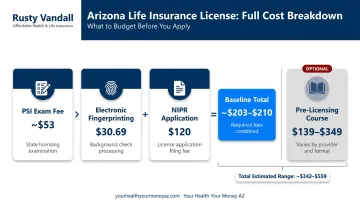
Here's the full cost breakdown:
| Item | Cost |
|---|---|
| PSI exam fee (per attempt) | ~$53 |
| Electronic fingerprinting | $30.69 |
| NIPR license application | $120 |
| Baseline total | ~$203–$210 |
| Optional pre-licensing course | $139–$349 |
The baseline regulatory cost — exam, fingerprints, and application — runs just over $200. Add a prep course and the total rises to $340–$560 before you earn your first commission.
Renewal costs are modest but worth budgeting for. CE courses covering the 4-year cycle typically run $50–$150 total — WebCE, for example, offers 48-hour Arizona CE packages starting around $59.95, plus a $1.50/hour state filing fee.
Fees change periodically — confirm current amounts directly with DIFI, PSI, and NIPR before you apply.
Continuing Education and License Renewal in Arizona
CE Requirements
Arizona resident life insurance producers must complete 48 hours of approved CE every 4 years, including a mandatory 6 hours of ethics training. Your license expires on the last day of your birth month, every four years.
Agents selling annuity or long-term care products face additional specialized training requirements. Verify current hours on DIFI's CE page — standard CE does not automatically cover those product lines.
Renewal Process
- The renewal window opens 90 days before your expiration date
- Renewal is completed online through DIFI
- Missing the deadline results in a $100 late fee; a short grace window may allow late renewal (confirm the current period on NIPR's renewal instructions)
- A lapsed license that can't be reinstated requires starting the process over
Nonresident license holders are not required to complete Arizona's 48-hour CE. They satisfy their home state's CE requirements.
What to Do After Getting Licensed: Building Your Career in Arizona
Choosing Your Career Path
The captive vs. independent decision touches nearly every aspect of your career: income potential, client relationships, and day-to-day flexibility.
- Captive agents get built-in structure: training programs, marketing support, and often a base salary or draw. The trade-off is limited carrier options, which can sometimes put you in the position of recommending a product because it's what you have rather than because it's the best fit.
- Independent agents carry more responsibility for building their own systems but can contract with multiple carriers and serve clients more objectively. The earnings ceiling is generally higher, but it takes longer to establish a book of business.
The Value of Specialization
Arizona's demographics create strong demand for agents who specialize. The state has one of the largest and fastest-growing retiree populations in the country, which translates directly to sustained demand for Medicare planning, life insurance, and retirement income solutions.
Agents who develop niche expertise — whether in Medicare Advantage, ACA plans, or retirement solutions like indexed universal life products — tend to build more loyal, referral-driven practices. Rusty Vandall of Your Health Your Money AZ is one example: by focusing on ACA health insurance, Medicare planning, and retirement solutions, he's built a client base spanning Arizona and multiple states — driven largely by referrals.
Income Expectations
According to ZipRecruiter's June 2026 data, the average life insurance agent in Phoenix earns approximately $88,337 per year. Entry-level agents starting on commission typically earn less until they build a book of business. Experienced agents with strong referral networks and diversified product knowledge regularly earn above the state average.
Income varies significantly based on whether you're salaried, commission-only, or on a hybrid structure — and whether you're working a captive or independent model.
Immediate Next Steps After Licensing
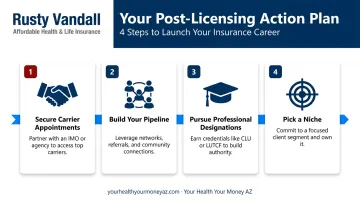
- Connect with an IMO or agency to secure carrier appointments — you can't legally sell without them
- Build your pipeline through personal networks, community involvement, and referrals from day one
- Pursue professional designations like the CLU (Chartered Life Underwriter) or LUTCF to strengthen credibility over time
- Pick a niche and commit — agents who thrive in Arizona typically become the go-to resource for a specific client segment
Frequently Asked Questions
How much does it cost to get a life insurance license in Arizona?
The baseline regulatory costs are: exam fee (~$53), fingerprinting ($30.69), and NIPR application ($120), totaling roughly $203–$210. Add an optional pre-licensing course and you're looking at $340–$560 total. Verify all fees directly with PSI, DIFI, and NIPR before applying.
How much does a life insurance agent make in Arizona?
ZipRecruiter puts the average at around $88,337 per year in Phoenix as of mid-2026, though entry-level agents typically start lower on commission-only structures. Experienced agents with established books of business earn significantly more, particularly those specializing in Medicare or retirement planning.
Is becoming a life insurance agent worth it?
For those willing to build a client base, yes. The barrier to entry is low — no degree required, under $600 to get licensed — and Arizona's growing retiree population creates durable demand. Income potential scales with effort and specialization.
Do I need a college degree to become a life insurance agent in Arizona?
No degree is required. DIFI's licensing requirements focus on age, lawful presence, passing the PSI exam, and completing fingerprinting. The BLS Occupational Outlook Handbook notes that insurance sales agents typically need a high school diploma.
How long does it take to get a life insurance license in Arizona?
Most candidates complete the full process — studying, exam, fingerprinting, and DIFI approval — in four to six weeks. That said, fingerprint processing through DPS and the FBI can take up to 90 days, so submit early.
Can I sell life insurance in other states with my Arizona license?
An Arizona resident license doesn't automatically authorize sales in other states. You'll need to apply for a nonresident license in each additional state. Arizona participates in the NIPR reciprocity system, which streamlines the application process for most states.