
Introduction
Picture this: your Medicare card arrives in the mail a few weeks before your 65th birthday. You see two letters on the front — "A" and "B" — and wonder what exactly each one covers and whether you're automatically protected the next time you need a hospital stay or a doctor visit.
You're not alone in that confusion. Millions of Americans enter Medicare each year without a clear picture of how the two parts work, or where they fall short.
Medicare Part A and Part B together make up Original Medicare, the federal health insurance program administered by the Centers for Medicare & Medicaid Services. Part A handles facility-based care; Part B covers the medical services surrounding it.
Together they provide broad coverage — but they also have notable gaps that create real financial exposure if you're not prepared.
This guide breaks down what each part covers, what it costs in 2026, and where coverage ends — including the gaps worth planning around before you enroll.
Key Takeaways
- Part A covers inpatient hospital stays, skilled nursing facility care, hospice, and some home health care — most people pay $0 in monthly premiums
- Part B covers doctor visits, outpatient services, preventive care, and durable medical equipment — the 2026 standard premium is $202.90/month
- Original Medicare (Parts A + B) excludes dental, vision, hearing, and prescription drugs
- Original Medicare has no annual out-of-pocket cap — unlimited cost exposure is possible without supplemental coverage
- Late enrollment can trigger permanent Part B premium penalties if you miss your Initial Enrollment Period
Medicare Part A vs. Part B at a Glance
The table below covers the key differences between Part A and Part B — premiums, deductibles, coinsurance, and what each part actually covers.
| Dimension | Medicare Part A | Medicare Part B |
|---|---|---|
| Coverage Focus | Inpatient/facility-based care | Outpatient/provider-based care |
| Monthly Premium (2026) | $0 for most; $311 or $565 if fewer than 40 work quarters | $202.90 standard; higher with IRMAA |
| Annual Deductible (2026) | $1,736 per benefit period | $283 per year |
| Coinsurance | $0 for Days 1–60; $434/day Days 61–90; $868/day lifetime reserve days | 20% of Medicare-approved amount after deductible |
| Common Services | Hospital stays, SNF rehab, hospice | Doctor visits, labs, preventive care, DME |
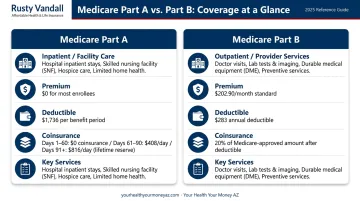
One important distinction: Part A's deductible resets with each benefit period, not once per calendar year. You can be charged it more than once in a single year if you're admitted, discharged, and readmitted after 60 days.
What Is Medicare Part A?
Part A is hospital insurance. It activates when you're formally admitted as an inpatient, and that distinction matters more than most people realize.
What Part A Covers
According to Medicare.gov, Part A covers four main categories:
- Inpatient hospital care — semi-private room, meals, general nursing, and medically necessary services
- Skilled nursing facility (SNF) care — following a qualifying hospital stay of at least 3 consecutive inpatient days
- Hospice care — for beneficiaries with a terminal diagnosis
- Limited home health care — when ordered by a physician and meeting specific criteria
A critical nuance: the benefit period begins the day you're admitted and ends after you've been out of the hospital or SNF for 60 consecutive days. There's no annual cap on benefit periods, meaning the $1,736 deductible can hit more than once in a year.
The Inpatient vs. Observation Distinction
If a hospital places you under observation status rather than formally admitting you as an inpatient, your stay is billed under Part B, not Part A. This directly affects SNF coverage: observation days don't count toward the required 3-day qualifying hospital stay. Many patients don't discover this until after discharge.
What Part A Does NOT Cover
- Private rooms (unless medically necessary)
- Personal comfort items (TV, phone if billed separately, razors)
- Private-duty nursing
- Long-term custodial care in a nursing home
That last point catches many people off guard. Medicare covers skilled rehabilitation in a nursing facility, but not indefinite custodial care when someone can no longer live independently.
Common Part A Scenarios
- A hip replacement requiring a 4-day hospital stay
- A stroke followed by transfer to a skilled nursing facility for rehabilitation
- A terminal cancer diagnosis requiring transition to hospice care
What Is Medicare Part B?
Part B is medical insurance. It covers services and supplies needed to diagnose or treat a medical condition, plus preventive care. Where Part A covers care inside a facility, Part B covers almost everything else.
What Part B Covers
- Physician and specialist services — primary care visits, specialist referrals, consultations
- Outpatient care — surgery centers, observation stays, diagnostic testing
- Preventive services — annual wellness visits, cancer screenings, vaccines, cardiovascular blood tests
- Durable medical equipment (DME) — wheelchairs, walkers, CPAP machines, hospital beds
Part B pays 80% of the Medicare-approved amount after the annual deductible. You cover the remaining 20% out of pocket — with no annual cap on that exposure.
The $0 Preventive Services Benefit
Many preventive services cost $0 when your provider accepts Medicare assignment. This includes:
- Annual wellness visits
- Screening mammograms
- Colorectal cancer screenings
- Depression screenings
- Cardiovascular disease screenings
- Cervical and vaginal cancer screenings
These are covered at no cost-sharing — but only when your provider accepts assignment. Always confirm before your appointment.
Two Benefits Beneficiaries Often Miss
Two coverage areas that often catch people off guard:
- Ambulance transportation — covered when other transport would endanger your health; you pay 20% after the deductible
- Outpatient mental health — psychiatric evaluation, medication management, and individual or group psychotherapy are all covered at 20% coinsurance after the deductible
The Late Enrollment Penalty
Understanding what Part B covers is only half the equation — knowing when to enroll matters just as much. For each 12-month period you were eligible but didn't sign up, your premium increases by 10%, and that penalty sticks for as long as you have Part B.
The exception: if you're actively covered through an employer group health plan based on current employment, you may qualify for a Special Enrollment Period without penalty.
Medicare Part A and Part B Costs in 2026
Part A Cost Summary
Per the CMS 2026 Medicare Parts A & B Premiums and Deductibles fact sheet:
| Cost Type | 2026 Amount |
|---|---|
| Premium (40+ work quarters) | $0 |
| Premium (30–39 quarters) | $311/month |
| Premium (fewer than 30 quarters) | $565/month |
| Hospital deductible (per benefit period) | $1,736 |
| Hospital coinsurance, Days 61–90 | $434/day |
| Hospital coinsurance, lifetime reserve days | $868/day |
| SNF coinsurance, Days 21–100 | $217/day |
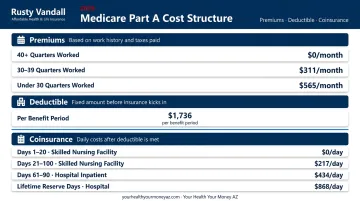
Days 1–20 in a skilled nursing facility are covered at $0; cost-sharing begins on Day 21.
Part B Cost Summary and IRMAA
The standard Part B premium is $202.90/month in 2026. Higher earners pay more through Income-Related Monthly Adjustment Amounts (IRMAA), based on 2024 modified adjusted gross income:
| Individual Income (2024 MAGI) | 2026 Monthly Premium |
|---|---|
| ≤$109,000 | $202.90 |
| $109,001–$137,000 | $284.10 |
| $137,001–$171,000 | $405.80 |
| $171,001–$205,000 | $527.50 |
| $205,001–$499,999 | $649.20 |
| ≥$500,000 | $689.90 |
The Out-of-Pocket Risk
Original Medicare has no annual out-of-pocket maximum. Unlike most private insurance plans, there's no ceiling on what you could owe in a given year under Parts A and B alone. A serious illness — cancer treatment, a major cardiac event, extended rehabilitation — can generate costs with no cap on your total exposure.
According to KFF, in 2022, 3.2 million Medicare beneficiaries had no supplemental coverage at all, leaving them fully exposed to this unlimited cost structure.
Two coverage options can close this gap. Medicare Advantage (Part C) requires plans to include an annual out-of-pocket cap on covered services. Medigap (Medicare Supplement) policies pay alongside Original Medicare — covering deductibles and coinsurance — to reduce or eliminate your share of costs.
Gaps in Original Medicare: What Parts A and B Don't Cover
Original Medicare covers a lot — but the gaps are significant and predictable.
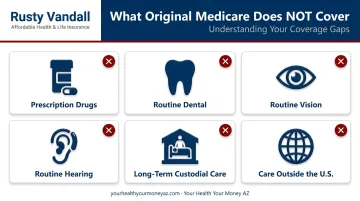
What's Not Covered
Per Medicare.gov's not-covered page:
- Prescription drugs — Part A and B do not include outpatient drug coverage; a standalone Part D plan is required
- Routine dental care — cleanings, fillings, extractions, and dentures are excluded
- Routine vision — eye exams for prescription glasses are not covered
- Routine hearing — hearing aids and fitting exams are excluded
- Long-term custodial care — nursing home care for daily living assistance is not covered
- Care outside the U.S. — Medicare generally does not pay for services received abroad
How to Fill the Gaps
There are two main paths:
- Keep Original Medicare and add supplements: Pair a standalone Part D drug plan with a Medigap policy to cover deductibles, coinsurance, and out-of-pocket costs. This preserves the flexibility to see any Medicare-accepting provider nationwide.
- Switch to Medicare Advantage (Part C): Most plans bundle prescription, dental, vision, and hearing coverage into one plan, often at lower premiums, though typically within a provider network.
Both approaches have real trade-offs. The right choice depends on your health status, preferred doctors, prescription needs, and budget, and it varies by plan and location.
An independent Medicare agent can compare options across multiple carriers and help you weigh the trade-offs based on your specific situation. Rusty Vandall at Your Health Your Money AZ specializes in Medicare Planning and serves clients across Arizona and beyond. Because he works independently, his focus is finding coverage that fits your needs. Reach him at 602-291-5169 or request a no-cost consultation on his website.
Frequently Asked Questions
What is Plan A and Plan B for Medicare?
Medicare Part A is hospital insurance covering inpatient stays, skilled nursing facility care, hospice, and some home health care. Part B is medical insurance covering doctor visits, outpatient services, preventive care, and durable medical equipment. Together, they form Original Medicare.
What does Medicare A and B cost per month?
Part A has a $0 premium for most people with 40 or more work quarters. Part B carries a standard monthly premium of $202.90 in 2026, though higher-income earners pay more through IRMAA surcharges based on income reported two years prior.
Does heart failure qualify for Medicare?
Heart failure alone doesn't qualify someone for Medicare. Eligibility is based on age (65+), qualifying disability through Social Security (SSDI after 24 months), ESRD, or ALS. Once enrolled, Medicare does cover heart failure treatment under both Parts A and B.
What is the difference between Medicare Part A and Part B?
The key distinction is the care setting. Part A covers care received as a hospital inpatient or in a facility — skilled nursing, hospice. Part B covers care in outpatient settings — doctor's offices, clinics, labs — plus preventive services.
Do I need both Medicare Part A and Part B?
Most people benefit from enrolling in both. Part A alone leaves outpatient and physician services uncovered, and delaying Part B enrollment without qualifying employer coverage can trigger a permanent premium penalty.
Can I delay enrolling in Medicare Part B if I'm still working?
Yes — if you're actively covered through an employer group health plan based on current employment, you can delay Part B without penalty. Medicare acts as secondary payer when the employer has 20 or more employees, but different rules apply to smaller employers, so confirm your situation with HR before delaying.