
Introduction
Employer health coverage ends the day you retire — but Medicare doesn't start until age 65. For early retirees, that gap can last years and cost thousands of dollars without the right plan in place.
According to the KFF 2025 Employer Health Benefits Survey, only 27% of large employers currently offer retiree health benefits — down from 41% in 1999. That declining access puts the responsibility on individuals to understand their options and plan ahead.
"Retirement insurance" covers more ground than most people expect. This guide addresses the full picture:
- Employer-sponsored retiree health plans
- ACA Marketplace coverage
- Medicare (Parts A through D)
- Medigap supplemental plans
- Long-term care insurance
Each section covers what the plan is, who it's for, and how it fits into a complete retirement coverage strategy.
Key Takeaways
- Retirement insurance planning goes beyond Medicare — health, supplemental, and long-term care coverage all factor in based on your age and situation.
- Early retirees under 65 can bridge coverage through ACA Marketplace plans, COBRA, Medicaid, or a spouse's plan.
- Medicare doesn't cover everything; Medigap, Medicare Advantage, and Part D plans fill critical gaps.
- ACA Marketplace plans protect against pre-existing condition exclusions — retiree-only employer plans and late Medigap enrollment do not.
- Starting your insurance review 6–12 months before retirement helps you avoid costly penalties and missed enrollment windows.
What Are Retirement Insurance Plans?
Retirement insurance plans are any insurance products designed to protect your health and finances after you leave full-time work. That includes:
- Employer-sponsored retiree health plans (if your former employer offers them)
- Government programs like Medicare and Medicaid
- Individually purchased policies from the ACA Marketplace, Medigap insurers, or long-term care carriers
The Shrinking Employer Safety Net
The days of retiring with generous employer-provided health coverage are largely over. Today, just 27% of large firms offer retiree health benefits, compared to 41% in 1999. For smaller employers, the gap is even wider. Only about 3% of private-sector establishments offered health benefits to Medicare-eligible retirees in 2022, according to EBRI.
That leaves most retirees responsible for building their own coverage from scratch.
Why Getting This Wrong Is Costly
Coverage gaps aren't just inconvenient — they come with real financial consequences:
- Late enrollment penalties for Medicare Parts B and D follow you for life
- Out-of-pocket costs in Original Medicare can be substantial without supplemental coverage
- Losing the Medigap guaranteed-issue window means future underwriting risk if you have health conditions
The earlier you map out your coverage options, the more choices — and leverage — you have when it counts.
Types of Retirement Insurance Plans
Employer-Sponsored Retiree Health Plans
Some employers and unions provide group health coverage to retired employees, often structured similarly to active-employee plans. The key caveat: these benefits can be reduced or eliminated unless the employer made a specific, legally binding commitment. Review your plan documents carefully — "we intend to provide coverage" is not the same as a contractual guarantee.
Medicare (Parts A, B, C, and D)
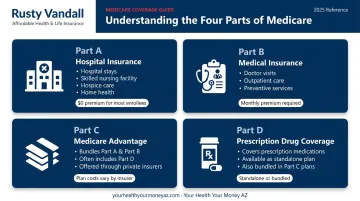
Medicare is the federal health program for individuals 65 and older (and some people with disabilities). Each of its four parts covers a distinct area of care:
| Part | Coverage | Notes |
|---|---|---|
| Part A | Hospital, skilled nursing, hospice, home health | Most people pay $0 premium |
| Part B | Doctor visits, outpatient care, preventive services | Monthly premium required |
| Part C | Medicare Advantage — bundles A, B, and usually D | Offered through private insurers |
| Part D | Prescription drug coverage | Separate plan or bundled with Part C |
As of early 2025, Medicare Advantage enrollment reached 34.4 million — representing 55% of all Medicare-eligible beneficiaries.
Medigap (Medicare Supplement Insurance)
Medigap policies are sold by private insurers and help pay costs Original Medicare doesn't cover — copayments, coinsurance, and deductibles. Over 14.5 million Americans currently carry a Medigap policy.
The most popular plans are Plan G (covering 39% of Medigap policyholders), Plan F (36%), and Plan N (10%).
The critical timing rule: the 6-month Medigap Open Enrollment window opens when you first get Part B at age 65. During this window, insurers cannot use medical underwriting. Miss it, and you may face higher premiums or denial based on health history in most states.
ACA Marketplace Plans
For retirees under 65 who need individual coverage, ACA Marketplace plans are the primary option. Income-based premium tax credits can substantially reduce monthly costs — and since retirement income is often lower than peak earning years, many early retirees qualify for substantial subsidies.
Long-Term Care Insurance
Medicare does not cover most long-term care services — nursing home stays, assisted living, or in-home care. A private nursing home room runs a median of $10,798 per month in 2025, and 70% of people who reach age 65 will develop severe long-term care needs at some point.
Premium timing matters here. A 55-year-old male pays roughly $2,200 annually for a standard policy; waiting until 65 pushes that to $3,280 — nearly 50% more.
Health Insurance Options If You Retire Before 65
Leaving work before Medicare eligibility means finding bridge coverage. You have four realistic options:
ACA Marketplace Plans
Retiring from a job qualifies you for a Special Enrollment Period (SEP) — typically 60 days before or after losing job-based coverage. You don't have to wait for Open Enrollment.
Premium tax credits are calculated based on estimated income, and retirement often pushes household income well below peak working years. This can significantly reduce your monthly Marketplace premiums.
COBRA Continuation Coverage
COBRA lets you stay on your former employer's plan for up to 18 months, but you pay the full premium — the employer contribution disappears. Using the KFF 2025 benchmark of $9,325 annually for single employer coverage, COBRA could run $9,500+ per year (102% of plan cost).
Best used as a short-term bridge while evaluating other options — not a long-term solution.
Medicaid
If your income drops significantly after retirement, you may qualify for Medicaid. In states that expanded Medicaid under the ACA, eligibility covers adults with income up to 138% of the federal poverty level ($21,597 for an individual in 2025).
Ten states — including Texas, Florida, and Georgia — have not adopted expansion, so your options may vary depending on where you live.
Spouse's Employer Plan
If your spouse is still working, losing your own coverage is a qualifying event that typically opens a special enrollment window to join their employer plan as a dependent. For mixed-age couples, coordination is important: when one spouse becomes Medicare-eligible, the younger spouse needs separate coverage until they reach 65.
Once you do reach 65, Medicare becomes your primary coverage — and brings its own set of enrollment decisions to navigate.
How Medicare Fits Into Your Retirement Coverage
Enrollment Timing and Penalties
The Initial Enrollment Period (IEP) is a 7-month window: it starts 3 months before your 65th birthday month and ends 3 months after. Missing this window without qualifying coverage has lasting consequences:
- Part B penalty: 10% added to your monthly premium for every 12-month period you could have enrolled but didn't — permanent, for as long as you have Part B
- Part D penalty: 1% of the national base beneficiary premium ($38.99 in 2026) for every month you went without creditable drug coverage — also permanent
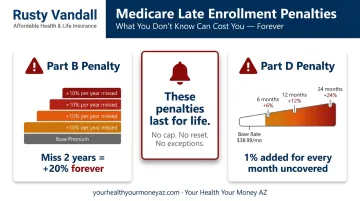
Consider what that looks like in practice: enrolling in Part B just 26 months late added $32.98 to a beneficiary's monthly premium in 2023, on top of the standard premium. That extra cost continues every month, for life.
Creditable Drug Coverage
"Creditable" drug coverage means your plan is expected to pay at least as much as standard Medicare Part D. If your retiree plan includes drug coverage, confirm in writing whether it's creditable. If it isn't — and you delay Part D enrollment expecting it to count — you'll face a permanent penalty when you do enroll.
Understanding whether your drug coverage qualifies matters even more when you're also coordinating with a retiree employer plan.
Medicare and Retiree Employer Plans: Who Pays First
When you have both Medicare and an employer retiree plan, Medicare pays first. The retiree plan acts as secondary coverage and picks up some remaining costs. The catch: if you were Medicare-eligible but skipped enrollment, the retiree plan can deny costs from that gap period.
Choosing Between Medicare Advantage and Original Medicare + Medigap
This is the key Medicare decision most retirees face. The core differences:
- Medicare Advantage (Part C): Bundled coverage including A, B, and usually D. Often includes dental, vision, and hearing. Plan networks vary — many are HMO or PPO structures.
- Original Medicare + Medigap: More predictable costs, broader provider access (any provider accepting Medicare), but requires a separate Part D plan.
If your employer retiree plan already covers gaps in Original Medicare, compare those benefits against standalone Medigap options before purchasing additional coverage.
Pre-Existing Conditions and Retirement Insurance
ACA Marketplace Plans: Strong Protections
Under the ACA, Marketplace plans cannot deny coverage, charge higher premiums, or limit benefits based on pre-existing conditions — including chronic conditions like diabetes, heart disease, or bipolar disorder. For early retirees with health histories, this protection makes Marketplace plans a genuinely accessible option.
Retiree-Only Employer Plans: Fewer Protections
Employer-sponsored plans covering only retirees (not current employees) are exempt from several ACA market reforms. These plans may impose annual or lifetime dollar limits on coverage and are not required to cover preventive services at no cost. If you're managing an ongoing condition, confirm the plan's dollar limits in writing before treating it as your primary coverage.
Medicare and Medigap
Medicare Parts A and B do not impose pre-existing condition exclusions. Medigap works differently, though. Key distinctions to know:
- Medigap plans purchased outside the guaranteed-issue window can require medical underwriting in most states
- Applicants may be charged more or denied coverage based on health history
- Connecticut, Massachusetts, Maine, and New York require year-round guaranteed-issue protections for Medigap, regardless of health history
If you're approaching 65 or recently lost employer coverage, enrolling during your guaranteed-issue window protects you from underwriting entirely.
How to Choose the Right Retirement Insurance Plan
Key Factors to Evaluate
When comparing options, work through these four dimensions:
- Coverage needs: Which prescriptions, specialists, and chronic condition management services do you use regularly?
- Total cost: Don't just compare premiums. Add deductibles, copays, and out-of-pocket maximums.
- Network restrictions: HMO plans require in-network providers; PPO plans offer more flexibility at higher cost.
- Coordination with existing coverage: How does each option interact with retiree coverage or Medicare you already have?
Why an Independent Agent Makes a Difference
Balancing those four factors across competing plans isn't straightforward — and that's where working with an independent agent pays off. Retirement insurance spans multiple markets (Medicare, ACA Marketplace, supplemental insurance), and no single carrier covers everything.
Rusty Vandall at Your Health Your Money AZ runs side-by-side comparisons across carriers simultaneously, including:
- Aetna, Humana, and UnitedHealthcare
- Cigna, Devoted Health, and Wellcare
- Additional carriers based on your state and situation
The right plan depends on your income, health status, provider preferences, and any existing retiree coverage you hold. Rusty works with clients across Arizona and many other states, helping retirees and pre-retirees evaluate Medicare Advantage, Medicare Supplement, Part D, and ACA Marketplace options with a focus on both short- and long-term needs.
Reach him at 602-291-5169 or through yourhealthyourmoneyaz.com.
Plan Ahead — Before Retirement, Not After
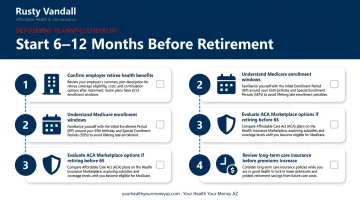
Insurance decisions made at retirement can carry lifelong financial consequences. Start your review at least 6–12 months before your planned retirement date to:
- Confirm whether your employer offers any retiree health benefits
- Understand your Medicare enrollment windows
- Evaluate ACA Marketplace options if you're retiring before 65
- Review long-term care insurance before premiums climb further with age
Frequently Asked Questions
What is the best insurance for retirement?
The right coverage depends on your age, health needs, income, and access to employer retiree benefits. Retirees under 65 often do best with ACA Marketplace plans plus income-based tax credits. Those 65 and older typically combine Medicare with either a Medigap policy or a Medicare Advantage plan.
Do health insurance plans cover chronic or pre-existing conditions like diabetes, bipolar disorder, or pancreatitis?
ACA Marketplace plans and Medicare cannot deny coverage or charge more based on pre-existing conditions. Medigap plans purchased outside the guaranteed-issue window and retiree-only employer plans have fewer protections, so plan selection matters significantly for anyone managing ongoing health conditions.
What happens to my health insurance when I retire before age 65?
Losing job-based coverage triggers a Special Enrollment Period for ACA Marketplace plans, giving you 60 days before or after separation to enroll. Other options include COBRA (up to 18 months, at full cost), Medicaid (if income-eligible), or joining a spouse's employer plan.
When should I sign up for Medicare?
Sign up during your Initial Enrollment Period — the 7-month window centered on your 65th birthday. Missing it without qualifying coverage results in permanent late enrollment penalties on both Part B and Part D premiums.
What is creditable drug coverage and why does it matter?
Creditable drug coverage is prescription coverage that pays at least as much as standard Medicare Part D. Retirees who delay Part D enrollment without creditable coverage face a permanent monthly penalty added to their Part D premium for every month they went uncovered.
Can my employer cut my retiree health benefits?
Private-sector employers are generally not required to maintain retiree health benefits unless they've made a specific, binding commitment. Review your plan documents carefully — and make sure you understand your other coverage options in case those benefits are reduced or eliminated.