The short answer is yes — coverage is available. But it requires understanding how insurers define pre-existing conditions, what types of coverage actually protect you, and one timing rule that can make or break your claim.
This guide covers everything: how pre-existing conditions are defined under travel insurance, your coverage options, how to qualify for a waiver, what won't be covered, and how to find the right plan before you depart.
Key Takeaways
- Travel insurers define pre-existing conditions broadly: any condition treated, examined, or medicated within the past 60–180 days qualifies
- A pre-existing condition waiver removes the standard exclusion if purchased within 14–21 days of your first trip deposit
- Original Medicare does not cover medical care outside the U.S. — retirees traveling abroad need separate travel health insurance
- Meeting waiver eligibility does not increase your premium
- Disclose all conditions honestly; misrepresentation can void your coverage entirely
What Counts as a Pre-Existing Condition for Travel Insurance?
Most travelers are surprised by how broadly insurers define pre-existing conditions — no formal diagnosis required.
The Standard Definition
Insurers typically classify a condition as pre-existing if you received treatment, a diagnosis, a medical exam, or a change in prescription medication within a defined window before purchasing your policy. Specific look-back periods vary by carrier:
- Allianz: 120 days before the plan purchase date
- Travelex: 90 days
- Travel Guard: 60, 90, or 180 days depending on the specific plan
So if you saw a cardiologist three months ago, adjusted a blood pressure medication, or had bloodwork ordered for an ongoing condition — that activity can trigger the pre-existing definition, even if nothing new was diagnosed.
Real-World Examples
To make this concrete:
- Hypertension: Diagnosed weeks before departure and managed with a medication change → likely pre-existing under most look-back windows
- Arthritic knee: Recently examined by an orthopedist, even without new treatment → the exam itself can qualify it
- Lupus in remission: If you experienced symptoms or had a related appointment during the look-back period, it likely counts
The "Stable Condition" Distinction
Many plans treat a condition differently if it was stable during the look-back period. Both Allianz and Travelex use controlled-medication language: a condition managed solely by prescription medication may not count as pre-existing if there was no change in prescription or dosage during the look-back period.
"Stable" generally means:
- No new symptoms requiring medical attention
- No new prescriptions or dosage adjustments
- No change in treatment plan
Whether your condition qualifies as stable directly affects your eligibility for a pre-existing condition waiver — the next section explains how to secure one.
Types of Coverage Available for Pre-Existing Conditions
Not all travel insurance is the same, and coverage for pre-existing conditions varies considerably depending on the plan type.
Comprehensive Travel Insurance with a Pre-Existing Condition Waiver
Comprehensive trip protection plans typically bundle trip cancellation, trip interruption, emergency medical, and evacuation coverage. These plans may include — or offer as an add-on — a pre-existing condition waiver that removes the standard exclusion.
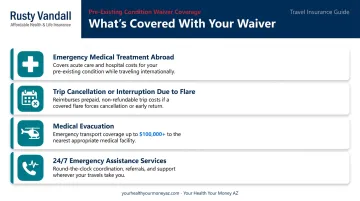
With a valid waiver, the plan covers:
- Emergency medical treatment related to your pre-existing condition while abroad
- Trip cancellation or interruption due to a pre-existing condition flare
- Medical evacuation, which can cost up to $100,000 or more out of pocket without insurance — the U.S. State Department notes air ambulance costs can reach $2,000 to $10,000 per hour
- 24/7 emergency assistance services
Travel Guard offers the Pre-Existing Medical Condition Exclusion Waiver on its Deluxe, Preferred, and Essential plans. Allianz and Travelex offer equivalent waiver provisions on eligible plans.
Standalone Travel Medical Plans and Acute Onset Coverage
Standalone travel medical insurance plans typically exclude pre-existing conditions outright. However, some include a narrow exception called acute onset of a pre-existing condition.
Acute onset, as defined by IMG, means a sudden, unexpected, rapidly progressing medical emergency that requires urgent care — for example, a cardiac event with no prior warning signs on that trip.
What acute onset does NOT cover:
- Chronic conditions being managed over time
- Gradual worsening of a known condition
- Congenital conditions
- Planned or ongoing treatment abroad
Squaremouth classifies pre-existing condition waivers and acute onset coverage as entirely separate benefits. Confusing the two is one of the most common reasons travel insurance claims are denied, so confirm which benefit your plan includes before you travel.
Annual Multi-Trip Plans: Verify Waiver Availability
Waiver availability on annual multi-trip plans varies by plan and is not a standard industry feature. Allianz does offer its Existing Medical Condition Benefit on certain annual AllTrips plans (Prime, Executive, Premier), but this is not universal. Verify waiver availability before purchasing any annual plan rather than assuming it applies.
How to Qualify for a Pre-Existing Condition Waiver
The waiver is the most valuable tool for travelers with chronic conditions — and timing is the single most important factor in qualifying.
The Purchase Window
Most waivers require buying the policy within a narrow window after your first trip payment:
| Carrier | Purchase Window |
|---|---|
| Allianz | Within 14 days of first deposit |
| Travel Guard (Deluxe) | Within 15 days of initial trip payment |
| Seven Corners | Within 20 days of initial trip payment |
| Travelex (Ultimate) | Within 21 days of first payment |
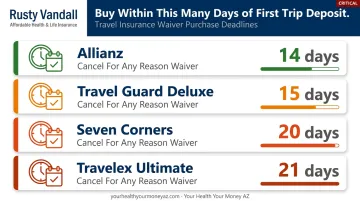
Miss that window and the waiver is gone. The insurer will apply the full look-back period to any filed claim, and claims related to your condition can be denied.
Full Eligibility Requirements
To qualify for the waiver, you typically must:
- Purchase the policy within the carrier-specified window after your first trip deposit
- Be medically stable at the time of purchase — no new symptoms, prescriptions, or treatment changes
- Insure the full non-refundable trip cost — airfare, hotel, tours, cruise, all of it
- Be medically able to travel on the policy purchase date
If additional non-refundable costs are added after your initial purchase — say, you book tours six weeks later — many plans require insuring those added costs within 14 days, or those expenses remain subject to the pre-existing condition exclusion.
Qualifying for a waiver does not raise your premium. It's purely an eligibility requirement, not an added surcharge.
What Travel Insurance Won't Cover: Common Exclusions
Understanding exclusions upfront prevents claim frustration later.
Common Exclusions Under Most Plans
- Traveling to receive treatment abroad (medical tourism) is excluded under most plans, including Travel Guard
- Mental, nervous, or psychological disorders — such as anxiety and depression — are excluded by Travelex and Travel Guard under most benefits; Travelex does make an exception for emergency medical and dental expenses
- Normal pregnancy or childbirth is not covered under pre-existing condition provisions for Allianz, Travel Guard, and most major carriers
- Any condition that was unstable during the look-back period remains excluded — no waiver overrides this unless the condition meets stability requirements
What's NOT Affected
Pre-existing condition exclusions only apply to claims directly related to that condition. A traveler with heart disease who breaks an ankle on a cobblestone street gets full coverage for the ankle — it has nothing to do with their cardiac history.
The Medicare Gap: Critical for Travelers 65+
Original Medicare (Parts A and B) generally does not cover medical care received outside the U.S. — Medicare.gov confirms this directly, with very limited exceptions. Retirees who assume their Medicare coverage travels with them are exposed to significant out-of-pocket risk abroad.
For Medicare-eligible travelers, a standalone travel medical plan or a Medicare Supplement plan with foreign travel emergency coverage can fill this gap.
Rusty Vandall at Your Health Your Money AZ works with Medicare clients on exactly this issue. His practice covers both Medicare Supplement planning and travel medical insurance. Reach him at 602-291-5169 for a no-cost consultation.
Practical Tips for Traveling with a Pre-Existing Condition
Three areas demand attention before any international trip: your documentation, your medications, and the medical facilities at your destination.
Before you book:
- Get written medical clearance from your primary care physician, especially if managing a chronic condition or recovering from surgery — some insurers require documentation that you were medically fit to travel at policy purchase
Managing medications:
- Pack all medications in original, labeled containers in your carry-on luggage — never checked bags
- Bring extra supply beyond your trip length in case of delays, per CDC guidance
- Verify with the foreign embassy of each destination country whether your medications are permitted — the State Department notes that a drug legal in the U.S. may be restricted or illegal abroad
Researching medical facilities:
- Quality of care varies significantly by country and region, and CDC notes that some facilities abroad may have lower credentialing or infection-control standards than U.S. hospitals
- The Joint Commission International's accredited organization search lets you identify JCI-accredited hospitals at your destination before departure
- In many countries, payment or a deposit is required before medical services are provided — know this before you need emergency care
How to Shop for the Right Plan
What to Compare Across Plans
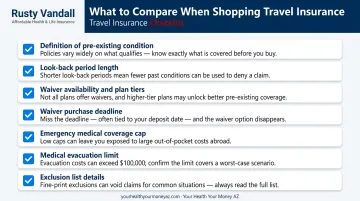
Not all travel insurance terms mean the same thing across carriers. When evaluating plans side by side, check:
- Definition of "pre-existing condition" — each carrier words this differently
- Look-back period length — 60 vs. 180 days makes a substantial difference
- Whether a waiver is available — and on which specific plan tiers
- Purchase deadline for waiver eligibility — 14 days vs. 21 days matters
- Emergency medical coverage caps — some plans cap at $50,000, others at $500,000 or more
- Medical evacuation limits — given evacuation costs can exceed $100,000, a $50,000 cap may not be enough
- Exclusion list — mental health, pregnancy, and medical tourism exclusions vary by plan
Working with an Independent Agent
Running through that checklist on your own — across a dozen carriers — is time-consuming. An independent agent does that work for you, with access to multiple plans across multiple carriers rather than steering you toward a single-provider pitch.
Rusty Vandall at Your Health Your Money AZ is a licensed independent agent who helps clients compare coverage options across carriers — including travel medical insurance. He matches coverage to each client's specific health situation and trip details. Rusty can be reached at 602-291-5169.
Always Disclose Pre-Existing Conditions
Disclose all pre-existing conditions honestly when applying. Misrepresentation — even unintentional omission — can result in claim denial, including for medical events unrelated to the undisclosed condition. Full disclosure is the only way to ensure your coverage actually works when you need it.
Frequently Asked Questions
Which travel insurance covers pre-existing medical conditions?
Comprehensive travel insurance plans that include a pre-existing condition waiver provide the broadest coverage. Carriers such as Allianz, Travel Guard, and Travelex offer waiver provisions on eligible plans, but coverage requires meeting specific purchase timing and medical stability criteria outlined in each plan.
Does Medicare cover me when I travel internationally?
Original Medicare (Parts A and B) generally does not cover medical care received outside the U.S., with very limited exceptions. Retirees traveling abroad should purchase a separate travel health insurance policy (or a Medicare Supplement plan with foreign travel emergency benefits) to avoid potentially large out-of-pocket costs.
What is the look-back period in travel insurance?
The look-back period is the window before your policy purchase date during which insurers review your medical history to determine whether a condition qualifies as pre-existing. Most plans set this window at 60 to 180 days, though the exact range varies by carrier.
What is acute onset of a pre-existing condition in travel insurance?
Acute onset refers to a sudden, unexpected medical emergency triggered by a pre-existing condition. Some travel medical plans cover this scenario even while excluding general pre-existing condition treatment — chronic conditions or gradual worsening do not qualify.
When should I buy travel insurance if I have a pre-existing condition?
Purchase coverage as soon as you make your first trip deposit. Most pre-existing condition waivers require purchase within 14 to 21 days of that initial payment — waiting longer eliminates waiver eligibility entirely.
Are pre-existing mental health conditions covered by travel insurance?
Mental and nervous health disorders are excluded from many travel insurance plans. Review a plan's exclusion list carefully before purchasing, and consult a licensed insurance professional if you're unsure whether a specific condition is covered.