Introduction
Picture this: a construction worker loses his hand in a machinery accident. He survives, his health insurance covers the surgery, and he's home recovering — but he's out of work for four months. His health plan covered the hospital bills. It covered nothing else.
That income gap is precisely what AD&D insurance addresses.
Accidental Death and Dismemberment (AD&D) insurance pays a cash benefit if you die or suffer a qualifying serious injury — loss of a limb, paralysis, loss of sight, hearing, or speech — caused by a covered accident. It's not health insurance, which covers medical treatment. It's not standard life insurance, which pays a death benefit regardless of cause. AD&D sits in between: it pays you (or your beneficiaries) when an accident permanently alters your life.
This guide covers what AD&D covers, how payouts work, how it compares to life insurance, and whether it belongs in your coverage plan — so you can make that call with confidence.
Key Takeaways
- AD&D pays a lump-sum benefit for accidental death or qualifying injuries like limb loss, paralysis, or loss of sight, hearing, or speech
- Coverage is limited to accidents only — illness, natural causes, and certain excluded activities don't qualify
- AD&D can be a standalone policy, a life insurance rider, or part of employer benefits
- No medical exam required — making it accessible even to those who can't qualify for standard life insurance
- AD&D works best as a supplement to life and health coverage — not a replacement for either
What AD&D Insurance Covers — and What It Doesn't
Most AD&D policies define a covered accident using language similar to Unum's sample policy, which describes "Accidental Bodily Injury" as bodily harm caused solely by external, violent, and accidental means — and not contributed to by any other cause. Common examples include car crashes, falls, machinery accidents, drowning, and fires.
Most policies also require that the covered loss occur within a defined period after the accident — some policies set this at 90 days, others at 365 days. The specific window varies by insurer, so reading your policy terms matters.
Covered Events
Most AD&D policies pay benefits for:
- Accidental death
- Loss of a limb or permanent loss of use of a limb
- Loss of sight in one or both eyes
- Loss of hearing or speech
- Permanent paralysis (partial, hemi-, para-, or quadriplegia)
- Coma resulting from a covered accident
Common Exclusions
AD&D policies are notably narrow. Standard exclusions across most policies include:
- Death or injury from illness or natural causes
- Suicide or self-inflicted harm
- Being under the influence of drugs or alcohol at the time of the accident
- Committing a felony
- Acts of war or active military service
- High-risk recreational activities (skydiving, bungee jumping, and similar activities often appear by name)
Employer-provided group AD&D plans often carry additional restrictions compared to individually purchased policies — so the exclusion list above may be longer, not shorter, depending on your coverage source.
The Drug Overdose Gray Area
Of all the exclusion categories, drug overdose generates the most claim disputes. Most AD&D policies explicitly exclude deaths involving voluntary drug use, narcotics, or intoxication — even when the overdose was unintentional. Insurers regularly deny these claims, including cases where fentanyl-laced substances were involved and the policyholder had no knowledge of the contamination.
If this exclusion concerns you, ask a licensed agent to pull the exact policy language before you buy — not after a claim is filed.
When a Medical Condition Triggers an Accident
Courts have addressed a subtle but important edge case: what happens when a pre-existing condition triggers an accident?
In Kellogg v. Metropolitan Life Insurance Co. (10th Circuit, 2008), an insured suffered a seizure while driving, crashed into a tree, and died from the crash injuries. MetLife denied the claim, citing an illness exclusion. The Tenth Circuit reversed in favor of coverage — reasoning that the crash injuries, not the underlying seizure, were the actual cause of death.
The key legal distinction:
- If a medical condition substantially contributes to the loss → coverage may be denied
- If the condition merely triggers an accident and the accident itself causes the death or injury → some courts have found coverage available
These cases turn on specific policy language and how courts in your jurisdiction interpret causation. If a claim has been denied on these grounds, consulting an insurance attorney — not just your insurer — is the practical next step.
How AD&D Insurance Payouts Work
AD&D policies don't pay the same benefit for every injury. They use a schedule of benefits that pays a percentage of the full "principal sum" based on the type and severity of the loss.
Here's a representative example based on published insurer schedules:
| Covered Loss | Benefit Paid |
|---|---|
| Accidental death | 100% |
| Loss of both hands or both feet | 100% |
| Loss of sight in both eyes | 100% |
| Quadriplegia | 100% |
| Loss of one hand or one foot | 50% |
| Paraplegia | 75% |
| Hemiplegia | 50% |
| Loss of sight in one eye | 50% |
| Loss of all four fingers, same hand | 50% |
| Loss of thumb and index finger | 25% |
| Coma benefit | 1% monthly (some plans) |
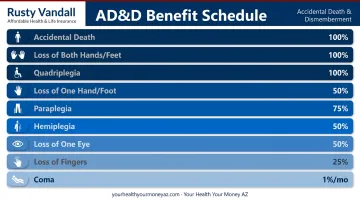
These percentages are policy-specific examples drawn from Cigna, Prudential, and MetLife plan summaries — your policy schedule may differ.
Who Receives the Payout
Accidental death benefits go to the named beneficiary. Injury and dismemberment benefits go directly to the policyholder.
How AD&D Riders Multiply Benefits
When AD&D is added as a rider to a life insurance policy, it can increase the total payout for accidental deaths. If a $500,000 life insurance policy carries a $500,000 AD&D rider and the insured dies in a car accident, the beneficiary receives $1,000,000 total. If the insured dies from illness, only the base $500,000 life benefit pays out.
Age-Based Benefit Reductions
Most AD&D policies reduce benefits at certain ages. Examples from published plan documents:
- Prudential: benefit reduces by 50% at age 70
- New York Life (one plan): reduces to 65% at age 65, 50% at age 70
- New York Life (another plan): reduces to 65% at age 70, 40% at age 75, 25% at age 80
If you're nearing age 65 or 70, review your current policy's schedule now — a benefit reduction at that threshold could affect how much coverage you actually carry into retirement.
AD&D Insurance vs. Life Insurance
The core difference: standard life insurance pays a death benefit regardless of cause, including illness, heart disease, and cancer. AD&D only pays for accidental death or qualifying accidental injuries. Life insurance doesn't cover non-fatal injuries at all — AD&D does.
| Feature | AD&D Insurance | Term Life Insurance |
|---|---|---|
| Covers accidental death | ✅ Yes | ✅ Yes |
| Covers illness-related death | ❌ No | ✅ Yes |
| Covers non-fatal injuries | ✅ Yes (dismemberment, paralysis, etc.) | ❌ No |
| Medical exam required | Typically no | Often yes (varies) |
| Cash value builds | ❌ No | ❌ No (term only) |
| Premium cost | Generally lower | Slightly higher for comparable coverage |
| Benefit payout | % of principal sum (injury) or full sum (death) | Fixed death benefit to beneficiary |
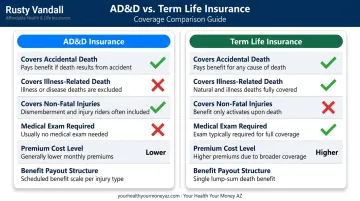
Why Someone Might Choose Both
Adding an AD&D rider to a life insurance policy expands coverage to include accidental injuries without the cost of a separate policy — and it's typically the more budget-friendly route. Corebridge Direct notes that accidental death coverage rates could be as low as $9 per month for some coverage levels.
When AD&D Makes Sense on Its Own
That said, not everyone can qualify for standard life insurance. For individuals with health conditions that make underwriting difficult, AD&D offers a path to some financial protection with no medical exam required and a straightforward application process.
Types of AD&D Insurance Plans
There are three main ways to get AD&D coverage:
- Standalone individual policy — purchased directly from an insurer; you own it regardless of employment
- Rider on a life insurance policy — added to an existing term or permanent policy at additional cost; often the most cost-efficient option
- Employer-sponsored group coverage — either employer-paid or voluntary through payroll deduction; convenient but tied to your job
The Portability Problem with Employer Coverage
If you leave your job, you typically lose employer-sponsored AD&D coverage immediately. Standalone and rider-based policies travel with you. That's worth factoring in if you change jobs frequently or are approaching retirement.
Comparing Your Options
If you're weighing standalone coverage against a rider or an employer plan, an independent agent can lay out your real options across multiple carriers. Rusty Vandall at Your Health Your Money AZ works with clients in Arizona and across the country to compare coverage side-by-side — finding the plan that fits each person's situation rather than a one-size-fits-all recommendation. You can reach him directly at 602-291-5169 for a no-cost consultation.
Is AD&D Insurance Worth It?
Who Benefits Most
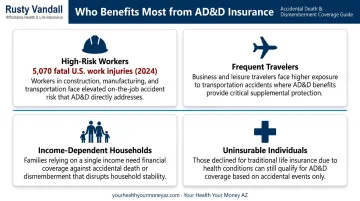
AD&D tends to deliver the most value for:
- Workers in physically demanding or high-exposure occupations — construction, transportation, manufacturing (BLS reported 5,070 fatal work injuries in the U.S. in 2024)
- Frequent travelers with elevated accident exposure
- People with dependents who rely on their income and want affordable supplemental protection
- Individuals who can't qualify for standard life insurance due to health history
The Honest Trade-Off
According to the CDC's 2023 National Vital Statistics data, accidents (unintentional injuries) accounted for just 7.2% of all U.S. deaths. The vast majority of deaths are illness-related — heart disease, cancer, stroke — none of which trigger AD&D benefits. That gap is why AD&D can't serve as your only death benefit protection.
That said, the National Safety Council reports that poisoning, falls, and motor vehicle accidents accounted for 84% of preventable injury-related deaths in 2024. If your lifestyle or occupation involves elevated exposure in those categories, the coverage gap AD&D fills becomes meaningfully more relevant.
Practical Recommendation
AD&D works well as a supplement, not a foundation. If you're deciding between AD&D and term life insurance and can only afford one, term life typically offers broader protection at a comparable or slightly higher cost. If you already have life and health coverage and want to fill the accidental injury gap affordably, AD&D or an AD&D rider is a logical addition.
Frequently Asked Questions
What is accidental death and dismemberment insurance?
AD&D insurance pays a cash benefit if you die or suffer a qualifying injury — such as loss of a limb, paralysis, or loss of sight, hearing, or speech — in a covered accident. Unlike health insurance, it pays a lump sum rather than covering medical bills. Unlike standard life insurance, it only applies to accidental events.
Is it worth getting accidental death insurance?
AD&D can be worth it as affordable supplemental coverage, especially for high-risk workers, frequent travelers, or people who can't qualify for standard life insurance. It shouldn't replace comprehensive life or health coverage, but it fills real gaps at a low cost.
What does accidental death and dismemberment actually cover?
Most policies cover accidental death, limb loss or loss of function, loss of sight or hearing, permanent paralysis, and accident-induced coma. Specific covered losses and benefit percentages vary by policy.
What is the difference between AD&D insurance and life insurance?
Life insurance covers most causes of death, including illness. AD&D only pays for accidental death or qualifying accidental injuries — meaning it won't pay out if you die from cancer, heart disease, or any natural cause. They're complementary, not interchangeable.
Does AD&D insurance cover drug overdose?
Most AD&D policies exclude drug overdose deaths — even unintentional ones — making this one of the most common reasons claims get denied. Review the exclusions section carefully for any language around voluntary drug use, narcotics, or intoxication.
Can I get AD&D insurance without a medical exam?
Yes. AD&D insurance typically requires no medical exam and no health questionnaire, making it faster and easier to obtain than standard life insurance — a real advantage for applicants with pre-existing health conditions.