Introduction
Shopping for small business insurance is confusing by design. You're sorting through policy types, coverage limits, exclusions, and carrier names — all while trying to run a business. According to Hiscox's 2025 Underinsurance Report, 74% of small business owners couldn't accurately define General Liability, and 77% didn't understand what a Business Owner's Policy includes. The system wasn't built with small business owners in mind.
Most business owners focus on coverage types and price — and overlook the buying process entirely. Where you purchase your policy shapes what options you have, who represents you when things go wrong, and how easily you can adapt as your business grows.
Two main paths exist: working with an independent agent or purchasing directly from a single insurance company. Choose the wrong one and you risk coverage gaps, no advocate when claims go sideways, and limited options when your needs change.
This article breaks down both approaches, how they compare, and which makes more sense for your situation.
Key Takeaways
- Independent agents shop multiple carriers for you; direct (captive) insurers sell only their own plans
- Agents are paid by carriers through commissions — typically no added cost to you
- 87.2% of commercial lines premiums are placed through independent agents, not direct channels
- Direct insurance works for straightforward, single-carrier needs with minimal comparison shopping
- Small businesses with employees, changing coverage needs, or multiple plan priorities benefit most from an independent agent
Independent Agent vs. Direct Insurance: Quick Comparison
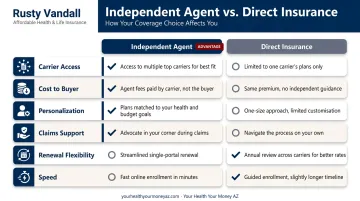
Here's how the two approaches stack up across the factors that matter most to small business owners:
| Factor | Independent Agent | Direct Insurance |
|---|---|---|
| Carrier access | Multiple (avg. 17 per agency) | One carrier only |
| Cost to buyer | Commission paid by carrier | Commission saved, but limited options |
| Personalization | Tailored to your specific risks | Standardized products |
| Claims support | Agent advocates on your behalf | Carrier rep works for the insurer |
| Renewal flexibility | Can re-shop the market | Must restart process elsewhere |
| Speed | Consultation required | Faster, often fully online |
One important nuance: carriers like State Farm use exclusive agent models — their agents represent only State Farm. Going independent means accessing a different set of carriers entirely, not the same ones at a different price point.
What Is an Independent Insurance Agent?
Per the NAIC's definition, an independent agent is a licensed professional who represents multiple insurance companies and sells and services policies across those carriers. The agent earns a commission from the insurer (not from you).
This commission structure matters. Because agents aren't paid by clients, there's no financial incentive to upsell unnecessarily. Their income depends on finding a policy that fits well enough for you to stay.
What Independent Agents Actually Do
The core value goes beyond finding a lower premium. A good independent agent:
- Conducts side-by-side comparisons across multiple carriers
- Translates policy language into plain recommendations
- Adjusts coverage as your business grows or adds employees
- Shops the market at renewal if rates rise
- Advocates on your behalf if a claim is disputed
The last point is worth singling out. When you file a claim with a direct insurer, their representative works for the company. An independent agent works the relationship: pushing back, escalating, and navigating the process alongside you.
The Agent vs. Broker Distinction
Independent agents represent their carrier partners, not the client in a legal sense (that's what brokers do). But their business model depends on satisfied, long-term clients, which creates a practical incentive to act in your interest. The NAIC's producer licensing framework holds agents to fiduciary standards around premium handling, and state insurance departments regulate licensing and conduct.
Agents like Rusty Vandall at Your Health Your Money AZ demonstrate this model in practice: working with carriers including Aetna, Cigna, Humana, and UnitedHealthcare to give Arizona small business owners and self-employed clients a real side-by-side comparison rather than a single-carrier pitch.
When Independent Agents Add the Most Value
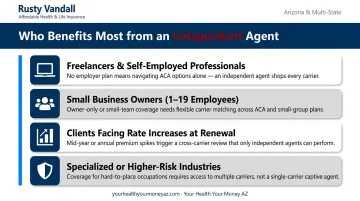
Independent agents consistently deliver more for:
- Freelancers and sole proprietors without employer-sponsored coverage navigating ACA marketplace plans for the first time
- Small employers comparing group health coverage options for staff
- Businesses that have received rate increase notices and need to shop alternatives quickly
- Industries with specialized liability exposure requiring non-standard policies
The Big I's 2024 Agency Universe Study found independent agencies hold an average of 17 carrier appointments , meaning a single agent can compare real options rather than steering you toward one product.
What Is Direct Insurance?
Direct insurance means purchasing a policy straight from a single insurance company — online, by phone, or through an in-house agent who represents only that carrier. No intermediary; you deal with the company itself.
The NAIC notes that direct purchasing may be less expensive because the company doesn't pay an agent commission. That's sometimes true — but it's not guaranteed, and the tradeoff is reduced market access.
Potential Advantages of Buying Direct
- Fast, self-service online purchasing with faster policy issuance
- Deep product knowledge from agents who specialize in one carrier's offerings
- Strong digital tools and 24/7 support at some carriers
- Simpler experience for straightforward, standardized coverage needs
Key Limitations for Small Businesses
- No cross-market comparison — you see one set of products, one price
- No independent advocate when a claim is denied or disputed
- Limited flexibility as your coverage needs evolve
- Switching carriers means rebuilding your coverage history from zero
When Buying Direct May Be Sufficient
Direct insurance works best for a sole proprietor who needs a single, standardized policy — say, a basic individual health plan — and already knows exactly what coverage they need. If your situation is straightforward and you're comfortable navigating plan details on your own, going direct is a viable option. The moment your needs grow more complex, that self-service model starts to show its limits.
Which Is Better for Small Business?
The data tilts heavily toward independent agents for most small businesses — though a direct carrier can work if your situation is genuinely simple and unlikely to change.
The Cost Reality
Many owners assume direct is cheaper because there's "no middleman." The NAIC acknowledges direct purchasing may cost less since no commission is paid — but that assumes the direct carrier's price is competitive in the first place. With an independent agent accessing 17 carriers on average, competition across the market often produces equal or better pricing than any single carrier can offer.
The Big I's 2025 Market Share Report shows independent agents placed 87.2% of commercial lines written premiums in 2024. That's not a coincidence — businesses with real coverage needs end up in the independent channel.
The Claims Factor
When a direct insurer's representative handles your claim, their job is to settle it within the carrier's guidelines. An independent agent has a different incentive: keeping you as a long-term client means ensuring you're treated fairly in the claims process.
No verified data quantifies a specific satisfaction gap between channels, but the incentive structure is clear: one side answers to the carrier, the other answers to you.
The Growth Problem
Claims disputes are one risk — coverage gaps are another. Hiscox found that 35% of small businesses had grown their operations but hadn't updated their insurance policies. Direct buyers face a real disadvantage here: when your needs change, you either accept whatever the carrier offers or restart the entire shopping process from scratch.
An independent agent adjusts coverage proactively. Add employees, expand into a new service area, or hit a revenue threshold — a good agent flags the coverage implications before a gap becomes a claim.
Situational Recommendations
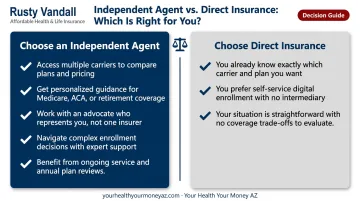
Choose an independent agent if:
- Your business has more than one employee
- You operate in a specialized or regulated industry
- You've had coverage gaps, claims disputes, or significant rate increases
- Your coverage needs are likely to evolve as you grow
- You want someone to advocate for you — not just sell to you
Choose direct insurance if:
- You need a single, simple policy and know exactly what you're buying
- Speed and fully digital self-service are your top priorities
- Your risk profile is genuinely straightforward and unlikely to change
Conclusion
For most small businesses — especially those with employees, changing risks, or limited time to compare dozens of carriers — an independent agent delivers more flexibility, broader market access, and ongoing support that direct purchasing can't replicate.
That said, direct insurance isn't wrong for everyone. A sole proprietor with simple, stable needs and the knowledge to evaluate coverage on their own can absolutely buy direct and come out fine.
If you're not sure which path fits your situation, Rusty Vandall at Your Health Your Money AZ works with major carriers across Arizona and multiple states, providing side-by-side health plan comparisons specifically for small business owners and self-employed individuals. Reach him at 602-291-5169 or submit a consultation request through the website — no obligation, just a straightforward look at your options.
Frequently Asked Questions
Is it better to buy insurance direct or work through an agent?
For most small businesses, working with an independent agent provides more value — multiple carriers to compare, coverage tailored to your risks, and an advocate if claims arise. Buying direct may be sufficient for very simple, standardized coverage needs where speed and self-service are the priority.
Do independent insurance agents cost more than buying direct?
Independent agents are typically paid by the carrier through commissions, not by you. Agents can often find competitive or lower premiums by comparing multiple carriers — so paying a middleman doesn't mean paying more.
Can an independent agent help with ACA health insurance for small businesses?
Yes. Independent agents who specialize in ACA plans can compare marketplace options side by side, identify subsidy eligibility, and match coverage to both health needs and budget — which is especially useful for self-employed individuals and small business owners. Rusty Vandall at Your Health Your Money AZ focuses specifically on this type of guidance.
When should a small business owner revisit their health insurance coverage?
Any significant business change warrants a coverage review — adding employees, shifting to self-employment, losing employer-sponsored coverage, or approaching Medicare eligibility. Annual open enrollment is also a natural checkpoint to confirm your current plan still fits your needs and budget.
What types of insurance do small businesses typically need?
Most small businesses need a combination of property and casualty coverage (such as general liability and workers' compensation) plus health coverage for themselves and any employees. For the health insurance component — including ACA marketplace plans and small group options — an independent agent can compare carriers and identify the right fit. Per the SBA's business insurance guidance, the right mix depends on your industry, size, and state requirements.
How do I know if an independent insurance agent is trustworthy?
Verify the agent holds a current state license through your state's insurance department — the NAIC provides a directory of state insurance departments for this purpose. Also check for complaints, ask for referrals, and pay attention to whether the agent asks about your needs before making any recommendations.