Introduction
Retiring before 65 means losing employer-sponsored health coverage while Medicare eligibility is still years away. Most people don't realize how expensive this gap can be until they're staring at their options.
According to EBRI's 2025 Retirement Confidence Survey, three in five retirees stopped working before age 65, with a median retirement age of 62. That creates a standard three-year gap before Medicare kicks in — three years where you're responsible for the full cost of your own coverage.
The KFF 2025 Employer Health Benefits Survey shows employers contribute an average of $7,885 annually for single coverage and $20,143 for family coverage. When you leave, that subsidy disappears — and without a plan, you absorb all of it.
This guide covers every viable coverage option for the pre-Medicare gap — ACA Marketplace plans, COBRA, spouse plans, Medicaid, and HSA strategies — along with how to evaluate cost, coverage gaps, and eligibility rules for each.
Key Takeaways
- Medicare starts at 65; anyone retiring earlier must arrange private or government-assisted coverage for the gap
- ACA Marketplace plans, COBRA, Medicaid, and HDHP/HSA combinations all carry distinct costs and eligibility rules
- ACA premium tax credits can dramatically reduce costs — but eligibility hinges on your household income
- Your best option depends on health needs, income, retirement length, and whether a spouse has employer coverage
- An independent insurance agent can compare plans across multiple carriers so you're not guessing
Understanding the Early Retirement Healthcare Gap
Medicare eligibility begins at 65 for most Americans, with limited exceptions for qualifying disabilities. Social Security retirement benefits can start as early as 62. That leaves a potential three-year window you have to cover entirely on your own.
When employer-sponsored insurance ends, the coverage typically stops on your last day of employment or at the end of that month. You then have a narrow 60-day window to elect new coverage before a gap occurs.
What This Costs Without Planning
A 60-year-old earning $65,000 faces a national average unsubsidized benchmark silver premium of $15,914 per year — roughly $1,326 per month — according to KFF's 2026 older-adult ACA analysis. That's before out-of-pocket costs.
And Fidelity estimates a 65-year-old may need $172,500 in after-tax savings just for healthcare expenses throughout retirement. Early retirees face those same costs, starting sooner.
This gap isn't an edge case. Most Americans retire around 62, which means navigating three or more years of self-funded coverage is a standard part of retirement planning.
Health Insurance Options for Early Retirees
ACA Marketplace Plans
The Health Insurance Marketplace (healthcare.gov) offers individual and family plans across four standardized tiers:
| Tier | Premium | Cost When You Need Care |
|---|---|---|
| Bronze | Lowest | Highest |
| Silver | Moderate | Moderate |
| Gold | Higher | Lower |
| Platinum | Highest | Lowest |
When you lose employer coverage, you qualify for a Special Enrollment Period (SEP) — you don't have to wait for Open Enrollment (November 1–January 15). The SEP window is 60 days from your coverage loss.
The bigger advantage for early retirees is subsidy eligibility. According to 2025 CMS enrollment data, 92% of Marketplace consumers received premium tax credits, with average premiums dropping from $619/month to $113/month after assistance. For a 60-year-old at $65,000 income, enhanced premium tax credits can bring that $15,914/year benchmark down to roughly $5,525/year.
Income management matters here. ACA subsidies are based on Modified Adjusted Gross Income (MAGI). Early retirees who control how much they withdraw from retirement accounts each year can keep their MAGI in a range that maximizes subsidy eligibility. Roth conversions, Social Security timing, and withdrawal sequencing are all levers worth reviewing before your last day of work.
COBRA Coverage
COBRA (Consolidated Omnibus Budget Reconciliation Act) lets you continue your existing employer group plan for up to 18 months after leaving work. Employers with 20 or more employees are required to offer it. Spouses and dependents may qualify for up to 36 months under certain circumstances.
The trade-off is cost. COBRA allows plans to charge up to 102% of the full plan cost — meaning you pay both the employee and employer share, plus a 2% administrative fee. Using KFF's 2025 average premiums and that 102% rule:
- Single coverage COBRA: ~$793/month
- Family coverage COBRA: ~$2,294/month
COBRA makes the most sense as a short-term bridge — particularly if you're mid-treatment, have established specialist relationships, or need time to evaluate long-term options. It's not a cost-effective long-term solution.
Spouse or Partner's Employer Plan
If your spouse or domestic partner is still employed and their plan covers dependents, this is often the most affordable path. The employer still subsidizes a portion of the premium, which keeps costs lower than individual market options.
Losing job-based coverage qualifies as a Special Enrollment Event, allowing you to be added to your spouse's plan outside of their employer's standard open enrollment window — typically within 30 days of the coverage loss.
Medicaid
Medicaid eligibility is income-based, and early retirement often means a sharp drop in earned income. ACA Medicaid expansion covers adults with incomes up to 138% of the Federal Poverty Level. Arizona has adopted Medicaid expansion, and AHCCCS (Arizona's Medicaid program) administers those benefits.
For early retirees drawing down assets slowly or living on modest portfolio withdrawals, Medicaid may provide low- or no-cost coverage. The limitation is network breadth — Medicaid provider networks are often narrower than commercial plans, which matters if you have specific specialists or facilities you rely on.
HDHP with an HSA
A High-Deductible Health Plan paired with a Health Savings Account is a strong strategy for early retirees in good health. The structure:
- Lower monthly premiums with higher deductibles
- Triple tax advantage on HSA contributions: deductible going in, tax-free growth, tax-free withdrawals for qualified medical expenses
- 2025 HSA limits: $4,300 self-only, $8,550 family
- 2025 HDHP minimum deductibles: $1,650 self-only, $3,300 family
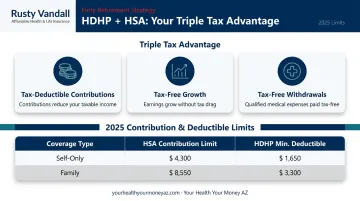
One critical timing rule: once you enroll in Medicare, your HSA contribution limit drops to zero. That makes the pre-Medicare years the ideal window to build up HSA balances. Funds accumulated before Medicare enrollment can later pay for Medicare Part B, Part D, and Medicare Advantage premiums — tax-free.
Other Options: Retiree Benefits and Part-Time Work
Two paths worth exploring before defaulting to individual coverage:
- Employer retiree health benefits — rare, but some large corporations and government employers extend coverage or subsidize premiums for retirees. Worth asking HR about before you finalize your retirement date.
- Strategic part-time work — some employers (Starbucks being a well-known example) offer health benefits to part-time employees. Working limited hours can maintain coverage while slowing portfolio drawdown.
One option to avoid: private health insurance purchased directly from a carrier outside the Marketplace. These plans do not qualify for ACA premium tax credits, which typically makes them more expensive than equivalent Marketplace plans.
Key Factors to Compare When Choosing a Plan
Premium vs. Total Out-of-Pocket Cost
A low premium with a high deductible can look attractive until you actually need care. Before choosing a plan, estimate your expected annual healthcare usage — prescriptions, specialist visits, any chronic conditions — and calculate total likely costs under each option, not just the monthly premium.
Provider Network Compatibility
Some plans use narrow networks that exclude your existing doctors, specialists, or preferred hospitals. For retirees managing ongoing health conditions, this can be the deciding factor.
- HMO plans: Lower cost, but require primary care referrals and restrict out-of-network care
- PPO plans: More flexibility for specialists and out-of-network providers, typically at higher cost
Verify that your specific providers are in-network before enrolling, not after the fact.
ACA Subsidy Cliff and Income Planning
ACA premium tax credits phase out at certain income thresholds, and crossing those thresholds even slightly can mean significantly higher costs. Key considerations:
- Roth conversions, capital gains realizations, and Social Security timing all affect MAGI
- Coordinating your withdrawal strategy with your subsidy target — ideally with a tax advisor or insurance professional — can save thousands
- Even slightly exceeding an income threshold can shift you into a significantly higher premium bracket
Pre-Existing Conditions and Alternative Coverage
All ACA Marketplace plans must cover pre-existing conditions without higher premiums or coverage denials. That protection does not apply to short-term health plans or health sharing ministries — both of which are increasingly marketed to early retirees.
If you have any chronic conditions, verify ACA compliance before enrolling in any non-Marketplace plan.
Prescription Drug Formularies
Drug tiers within a plan's formulary directly affect what you pay for maintenance medications. Two plans with nearly identical premiums can produce very different costs for the same drug. Before committing to any plan:
- Pull the full formulary and locate your specific medications
- Check which tier each drug falls under and what your cost-sharing would be
- Compare formularies side-by-side if you take multiple maintenance medications
Planning Ahead: What to Do Before You Retire
Start your insurance planning 6 to 12 months before your target retirement date. Waiting until the last few weeks leaves you with fewer options and less time to compare.
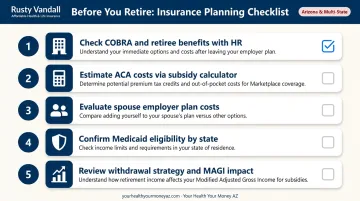
Checklist before retiring:
- Ask HR about COBRA costs and any available retiree health benefits
- Use the healthcare.gov subsidy calculator to estimate ACA plan costs at your expected retirement income
- Check whether your spouse's employer plan allows dependent enrollment and what it costs
- Confirm whether your expected income qualifies you for Medicaid in your state
- Review how your planned withdrawal strategy affects your MAGI and subsidy eligibility
Maximize your HSA now. Unused balances roll over indefinitely. HSA funds can be used tax-free for qualified medical expenses including dental and vision — and after age 65, that coverage extends to Medicare Part B, Part D, and Medicare Advantage premiums as well.
How much you withdraw from retirement accounts each year directly affects ACA subsidy eligibility, future Medicare premium surcharges (IRMAA), and Medicaid eligibility. A $5,000 difference in annual MAGI, for example, can push you into a higher IRMAA bracket or eliminate your ACA subsidy entirely — which is why income and insurance planning need to happen together, not separately.
How Your Health Your Money AZ Can Help
Rusty Vandall of Your Health Your Money AZ is a licensed independent insurance agent specializing in ACA Health Insurance, Medicare Planning, and Retirement Solutions. As an independent agent, he works with multiple major carriers — including Aetna, Cigna, Humana, UnitedHealthcare, and Wellcare — to offer side-by-side plan comparisons so you're never locked into one company's options.
For early retirees, that independence matters. The right coverage during the pre-Medicare gap depends on a combination of income level, health status, retirement timeline, and long-term Medicare transition planning — not a one-size-fits-all recommendation.
Rusty works with clients across two timeframes:
- Short-term: Bridging the gap from employer coverage to Medicare eligibility
- Longer-term: Comparing Medicare Supplement, Medicare Advantage, and Part D plans when the time comes
His process starts with your specific situation — income, health needs, and retirement timeline — and builds from there rather than defaulting to whatever's most popular.
Early retirees in Arizona and across the U.S. can reach Rusty at 602-291-5169 or request a no-cost consultation through the Your Health Your Money AZ website. You can specify your preferred contact time and the products you're interested in.
Frequently Asked Questions
How much will health insurance cost if I retire early?
Costs vary significantly by age, plan type, income, and location. A 60-year-old on an ACA Marketplace plan could pay as little as a few hundred dollars monthly with subsidies, or over $1,300/month without them. COBRA is typically the most expensive short-term option since you cover the full premium, roughly $793/month for single coverage based on 2025 averages.
How do I get health insurance if I retire at 62 in the USA?
Retiring at 62 triggers a Special Enrollment Period, giving you 60 days to enroll in an ACA Marketplace plan after losing employer coverage. Joining a spouse's employer plan, electing COBRA temporarily, or qualifying for Medicaid are all options worth evaluating based on your household income and situation.
Will health insurance cover pre-existing conditions if I retire early?
ACA Marketplace plans are legally required to cover pre-existing conditions without higher premiums or coverage denials. That protection does not apply to short-term health plans or health sharing ministries, which operate outside ACA rules, so read the fine print carefully before enrolling in any non-Marketplace option.
Can I use my HSA to pay for health insurance premiums in early retirement?
Generally, HSA funds can't pay standard health insurance premiums tax-free. Exceptions include COBRA premiums, premiums paid while receiving unemployment benefits, and, once you reach Medicare age, premiums for Medicare Part B, Part D, and Medicare Advantage plans. Medigap/supplement policies do not qualify.
What is the best health insurance option for someone retiring at 60?
For most healthy retirees with moderate income, an ACA Marketplace plan with premium tax credits is the most cost-effective path. The right choice still depends on your income, health status, and whether a spouse has employer coverage available. Those needing immediate continuity of care may start with COBRA while evaluating Marketplace options for the following year.
When can I enroll in health insurance after retiring early?
Losing job-based coverage is a qualifying life event that triggers a 60-day Special Enrollment Period for ACA Marketplace plans. Medicaid enrollment is available year-round for those who qualify. COBRA election must also be made within 60 days of receiving your coverage loss notice.