The gap between need and preparation is wide — and it's made wider by one persistent misconception: that Medicare will cover long-term care costs. It won't. Medicare only pays for skilled nursing care for a limited period after hospitalization. Ongoing help with bathing, dressing, or eating? That's your bill.
This guide covers everything you need to make an informed decision: what long-term care actually is, what insurance covers, how traditional and hybrid policies differ, what it costs, and how to determine whether coverage makes sense for your situation.
Key Takeaways
- LTC insurance covers assistance with daily activities like bathing, dressing, and eating — in settings from your home to a nursing facility
- Medicare does not cover custodial care; Medicaid only helps those who meet strict income and asset limits
- Two main policy types exist: traditional (use-it-or-lose-it) and hybrid (linked to life insurance or an annuity)
- Buying in your 50s means lower premiums and better odds of qualifying medically
- The right policy depends on your assets, health, and retirement goals — no single option fits everyone
What Is Long-Term Care and Why Does It Matter?
Long-term care means assistance with the routine tasks that illness, injury, or cognitive decline can make difficult or impossible. These tasks — known as Activities of Daily Living (ADLs) — include eating, bathing, dressing, toileting, transferring, and continence. Supervision due to cognitive impairment like Alzheimer's disease also qualifies.
Care can happen in many settings:
- In-home care — personal care aides or homemaker services at your residence
- Adult day care centers — structured daytime supervision and support
- Assisted living facilities — residential communities with daily assistance
- Memory care units — specialized environments for cognitive decline
- Skilled nursing homes — the highest level of residential care
The Numbers You Need to Know
- 70% of adults who reach age 65 will develop severe long-term services and support needs in their lifetime
- 48% will use some form of paid care
- The average person uses care for about 3 years — women average 3.7 years, men 2.2 years
- 20% of today's 65-year-olds will need care for more than 5 years
LTC needs aren't always permanent. Some people need a few months of recovery care after surgery; others need years of ongoing help. Understanding both the average case and the long-tail risk is what drives better coverage decisions.
The Medicare and Medicaid Gap
Medicare does not pay for custodial or personal long-term care. Per Medicare.gov, Medicare Part A may cover skilled nursing facility care after a qualifying 3-day inpatient hospital stay — but only for skilled care related to that stay, and only up to 100 days per benefit period. After day 100, Medicare pays nothing.
Medicaid does cover long-term care, but only for those who qualify financially. In most states, the asset limit is $2,000 for a single individual. Most middle-class Americans don't qualify until they've spent down most of what they've saved.
What Does Long-Term Care Insurance Cover?
LTC insurance pays a daily or monthly benefit (up to your pre-selected maximum) for covered care services once you meet the benefit triggers. Per IRS guidelines, those triggers require certification that you're unable to perform at least 2 of 6 ADLs for at least 90 days, or that you need substantial supervision due to severe cognitive impairment.
Covered Care Settings
A comprehensive policy typically covers all of the following:
- In-home personal care and homemaker services
- Home health care
- Adult day care
- Assisted living
- Respite care for family caregivers
- Hospice care
- Nursing home care
Narrower policies may cover only home care or only facility-based care. Always confirm what settings are included before you buy.
Elimination Periods
The elimination period is the number of days you pay out of pocket before insurance benefits begin — essentially a deductible measured in time. Common options are 30, 60, or 90 days. Most people today purchase coverage with a 90-day elimination period, which lowers the premium in exchange for greater initial out-of-pocket exposure.
Inflation Protection
Care costs rise over time. According to CareScout's 2025 Cost of Care Survey, assisted living costs rose 5% year-over-year in 2025, and nursing home costs continued climbing. A benefit amount that's adequate today could fall well short in 20 years without inflation protection.
Policies typically offer two options:
- Simple inflation: the benefit grows by a fixed dollar amount each year, keeping costs lower but building value more slowly
- Compound inflation: the benefit grows by a percentage of the prior year's value, building significantly more purchasing power over 20–30 years — at a higher premium
What LTC Insurance Does NOT Cover
- Care not specified in a licensed care plan
- Certain pre-existing conditions (especially in early policy years)
- Care provided informally by immediate family members in most cases
- Non-covered care settings listed in the policy exclusions
Traditional vs. Hybrid Long-Term Care Insurance Policies
The LTC insurance market has shifted dramatically. LIMRA's 2025 data shows hybrid/combination products now represent 92% of new individual LTC solution policies, with standalone traditional policies accounting for just 8%.
Each structure serves a different financial profile, so understanding the trade-offs is worth your time before committing.
Traditional Standalone LTC Insurance
You pay ongoing premiums (usually annually) for as long as the policy is active. When you need care and meet the benefit triggers, the policy pays.
The trade-off: if you never need care, you receive no financial return. This is often called the "use it or lose it" structure. Premiums have also historically been subject to rate increases, which has pushed many buyers toward hybrid options.
Hybrid Life + LTC Policies
These combine a life insurance death benefit with long-term care coverage. The death benefit can be accelerated to pay for qualifying LTC expenses, often paid out over 20 to 50 months. If you never need care, your heirs receive the remaining death benefit.
Some hybrid policies continue paying LTC benefits even after the original death benefit pool is exhausted — a meaningful protection against extended care needs.
Hybrid Annuity + LTC Policies
An annuity grows at a fixed rate and can be drawn down for qualifying LTC expenses under a qualified structure. The insurance component provides a benefit pool beyond the annuity's own value, extending protection if care needs outlast the annuity balance.
Side-by-Side Comparison
| Feature | Traditional LTC | Hybrid Life + LTC | Hybrid Annuity + LTC |
|---|---|---|---|
| Premium structure | Ongoing; subject to increases | Lump sum or fixed schedule | Lump sum or fixed schedule |
| Unused benefits | No return | Death benefit to heirs | Remaining annuity value |
| Upfront cost | Lower | Higher | Higher |
| Premium stability | Variable | Fixed | Fixed |
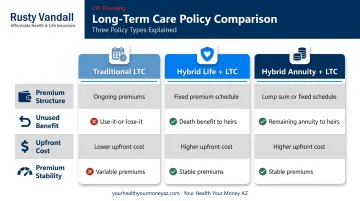
As an independent agent with access to multiple carriers, Rusty Vandall at Your Health Your Money AZ can place traditional and hybrid policies side by side — so you see the real cost difference, not just a single carrier's pitch.
Key Policy Features That Shape Your Coverage
Benefit Amount and Lifetime Maximum
You choose your daily or monthly benefit amount and your benefit period (how many years the policy pays). Multiply those together and you get your lifetime maximum benefit pool.
For example: a $200/day benefit with a 3-year benefit period creates a pool of roughly $219,000. That's the total the policy will pay before benefits are exhausted.
Most people choose benefit periods of 3 to 5 years rather than lifetime coverage. Here's why:
- Only 20% of people need care beyond 5 years, so lifetime coverage covers a small minority
- The premium jump for lifetime benefits is substantial compared to a 5-year policy
- Many people self-fund shorter gaps or eventually qualify for Medicaid
Tax Advantages of Qualified LTC Policies
Qualified LTC insurance policies come with meaningful tax benefits:
- Premiums may be deductible as medical expenses on your federal return, up to age-based IRS limits
- Benefits you receive are generally tax-free
2026 IRS eligible premium deduction limits (per Rev. Proc. 2025-32):
| Age at close of tax year | Maximum deductible premium |
|---|---|
| 40 or younger | $500 |
| 41–50 | $930 |
| 51–60 | $1,860 |
| 61–70 | $4,960 |
| Over 70 | $6,200 |
The per diem limit for tax-free LTC benefit payments in 2026 is $430/day. Benefits above this threshold may be taxable unless they correspond to actual care costs you incurred.
How Much Does Long-Term Care Insurance Cost?
What Determines Your Premium
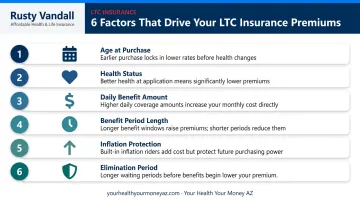
Six factors drive your LTC insurance premium:
- Age at purchase — the single biggest factor; younger buyers pay meaningfully lower premiums
- Health status — policies are medically underwritten; conditions can increase premiums or lead to denial
- Daily benefit amount selected — higher daily limits increase your premium proportionally
- Benefit period length — longer covered periods (2 vs. 5 years) raise costs
- Inflation protection — compound inflation protection adds meaningful cost
- Elimination period — longer waiting periods reduce premiums
Current Care Costs (CareScout 2025 National Medians)
| Care Setting | Annual Median Cost |
|---|---|
| In-home non-medical caregiver | $80,080 |
| Adult day health care | $24,700 |
| Assisted living community | $74,400 |
| Nursing home (semi-private room) | $114,975 |
| Nursing home (private room) | $129,575 |
Three years of in-home care at $80,000 annually runs $240,000 out of pocket without coverage — and nursing home costs nearly double that.
The Cost of Waiting
AALTCI data illustrates the premium difference between buying at 55 versus 65:
| Profile | Age 55 (level benefit) | Age 65 (level benefit) | Increase |
|---|---|---|---|
| Single male | $950/year | $1,750/year | ~84% |
| Single female | $1,500/year | $2,700/year | ~80% |
| Couple | $2,080/year | $3,750/year | ~80% |
Beyond cost, waiting raises health qualification risk. Conditions that develop in your 60s can disqualify you entirely. Most advisors recommend purchasing in your 50s — or even late 40s — to balance affordable premiums with a realistic chance of qualifying.
Should You Buy Long-Term Care Insurance?
LTC Insurance Likely Makes Sense If You:
- Have $75,000–$100,000+ in savings beyond your home (assets worth protecting from care costs)
- Can afford premiums without straining your monthly budget
- Want control over where and how you receive care
- Prefer not to rely on family members for caregiving
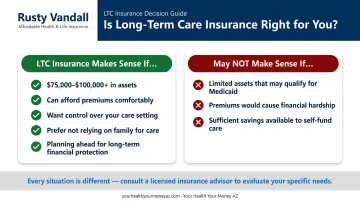
It May NOT Make Sense If You:
- Have limited assets and would qualify for Medicaid relatively quickly
- Cannot afford premiums without financial hardship
- Have sufficient savings and investments to confidently self-fund care needs
Alternatives Worth Considering
LTC insurance isn't the only option. Other approaches include:
- Self-funding through dedicated retirement savings accounts
- Proceeds from downsizing — selling a home to fund care costs
- Reverse mortgages — accessing home equity without selling
- State Long-Term Care Partnership Programs — allow a qualified LTC policy to protect assets equal to benefits paid before Medicaid kicks in, available in most states
Choosing the right path means weighing your retirement income, assets, health history, and family situation together. Rusty Vandall at Your Health Your Money AZ works with multiple carriers to compare LTC options alongside your broader retirement picture — so you see exactly how each choice affects your overall plan. Call 602-291-5169 for a no-cost consultation.
Frequently Asked Questions
Should I buy long-term care insurance?
It depends on your assets, health, and retirement goals. If you have savings to protect, can afford premiums comfortably, and want to ensure care options beyond Medicaid, LTC insurance is worth serious consideration. An independent agent with access to multiple carriers can compare traditional, hybrid, and alternative options side by side for your specific situation.
How much does long-term care insurance cost?
Premiums depend on your age, health, benefit amount, and policy type. As a rough benchmark, a healthy individual in their mid-50s might pay $950–$1,500/year for a traditional standalone policy with a modest benefit pool — with women typically paying more than men due to longer average care duration.
Does Medicare cover long-term care?
No. Medicare only covers skilled nursing facility care for up to 100 days after a qualifying hospital stay — with significant cost-sharing after day 20 — and does not cover custodial or personal care. Medicaid does cover LTC, but only after you've spent down assets to roughly $2,000 for a single individual.
What is the difference between traditional and hybrid long-term care insurance?
Traditional policies pay ongoing premiums with a use-it-or-lose-it structure — no benefit if you never need care. Hybrid policies combine LTC coverage with life insurance or an annuity, so unused benefits pass to heirs. Hybrids typically cost more upfront but feature level premiums and guaranteed benefits regardless of whether care is ever needed.
When is the best age to buy long-term care insurance?
Most advisors recommend your 50s. Premiums are meaningfully lower, and you're more likely to pass medical underwriting. Waiting until your 60s can increase premiums by 80% or more and raises the risk of being declined due to health conditions.
What does long-term care insurance typically NOT cover?
Most policies exclude care not specified in a licensed plan of care, certain pre-existing conditions (particularly in early policy years), informal care from family members, and non-covered settings. Always review the exclusions section of any policy before purchasing.