Unlike Medicare Advantage or Part D, Medigap doesn't have a simple annual enrollment period open to everyone. Whether you can switch — and what it costs — depends on timing, your state, and your medical history.
This article breaks down exactly when you can change plans without health questions, how to do it step by step, which conditions can affect your application, and what to do if switching isn't currently an option.
Key Takeaways
- Outside protected enrollment windows, Medigap insurers can deny coverage or charge more based on health status
- Your one-time Open Enrollment Period (OEP) at age 65, when you first enroll in Part B, is your strongest federal protection
- Guaranteed Issue Rights triggered by specific life events offer additional protected windows after your OEP
- Nine states (including California, Oregon, and Illinois) have birthday rules giving you an annual switching window
- A preexisting condition waiting period can be eliminated with six months of continuous creditable coverage before you apply
When Can You Change Medicare Supplement Plans with Preexisting Conditions?
Three scenarios give you protected access to Medigap coverage regardless of health history: your Open Enrollment Period (OEP), a Guaranteed Issue Right triggered by a life event, or a state-level protection like a birthday rule. Outside these windows, insurers can — and often do — use medical underwriting to evaluate or decline your application.
Medigap Open Enrollment Period — Your One Protected Window
The Medigap OEP begins the month you turn 65 and enroll in Medicare Part B. It lasts exactly six months. During this window, insurers cannot:
- Refuse to sell you a Medigap policy
- Charge more because of health problems
- Make coverage wait to start (except for limited preexisting condition rules)
Miss this window and you lose it permanently under federal law. There is no federal annual reset. A Medigap decision made at 65 locks in your protections. Make it count, because getting back in without underwriting later is far harder.
Guaranteed Issue Rights — When You Can Switch Without Health Questions
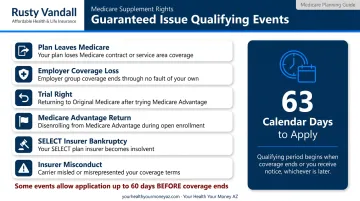
If you've missed your OEP, Guaranteed Issue Rights may still offer a protected path. These are federally protected windows triggered by specific life events — when one applies, insurers must accept your application regardless of health history.
Qualifying events include:
- Your Medicare Advantage plan leaves Medicare or stops serving your area
- You lose employer-sponsored retiree, union, or COBRA coverage that paid after Medicare
- You enrolled in Medicare Advantage during your first year of Medicare and want to switch back within 12 months (Trial Right)
- You dropped a Medigap plan to try Medicare Advantage for the first time and want to return within a year
- Your Medicare SELECT insurer goes bankrupt or you lose coverage through no fault of your own
- Your insurer misled you or failed to follow the rules
Timing matters: You generally have 63 calendar days from the date your prior coverage ends to apply. Some events allow you to apply up to 60 days before coverage ends. Missing the 63-day window forfeits the protection entirely, meaning you'll face full medical underwriting.
State-Level Birthday Rules and Annual Protections
Several states go beyond federal minimums and grant beneficiaries annual windows to switch without underwriting.
Nine states with birthday rules (as of 2024):
| State | Switch Window | Benefit Limit |
|---|---|---|
| California | 60 days after birthday | Same or lesser benefits |
| Oregon | 30 days before through 30 days after birthday | Same or lesser benefits |
| Idaho | 63-day period starting on birthday | Similar or lesser coverage |
| Illinois | 45 days starting on birthday (ages 65–75) | Equal or lesser benefits |
| Kentucky | 60 days starting on birthday | Same plan replacement |
| Louisiana | 63 days starting on birthday | Equal or lesser benefits |
| Maryland | Birthday through the following 30 days | Equal or lesser benefits |
| Nevada | 60+ days starting first day of birthday month | Same or lesser benefits |
| Oklahoma | 60 days starting on birthday | Equal or lesser benefits |
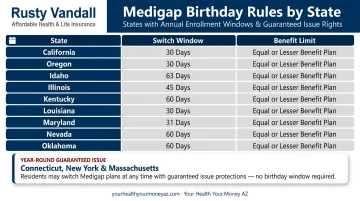
Three states — Connecticut, New York, and Massachusetts — offer even stronger protections with year-round guaranteed issue, meaning insurers must accept Medigap applications at any time without underwriting.
State rules change regularly. Always verify your state's current protections directly with your state insurance department before assuming a window applies to you.
How to Change Your Medicare Supplement Plan: Step by Step
Step 1: Confirm Your Enrollment Window and Eligibility
Determine which scenario applies to you:
- Are you within your OEP?
- Does a Guaranteed Issue event apply to your situation?
- Does your state have a birthday rule or year-round protections?
If claiming a Guaranteed Issue Right, gather documentation immediately — coverage termination letters, plan discontinuation notices, or other proof of the triggering event. You'll need these with your application.
Step 2: Review Your Current Coverage and Needs
Assess what you actually use before deciding what to switch to. Common reasons people switch:
- Paying for benefits they rarely use
- Wanting more comprehensive coverage (such as upgrading to Plan G)
- Finding lower premiums for identical benefits from a different carrier
One important note: all standardized Medigap plans with the same letter offer identical benefits regardless of insurer. Switching between carriers for the same plan letter is purely a cost decision.
Step 3: Compare Plans and Premiums Across Carriers
Premiums for the same Medigap plan letter can vary significantly between insurance companies — even though the benefits are exactly the same. Comparing carriers side by side is worth the time.
An independent agent can run multi-carrier comparisons in a single conversation, which saves considerable legwork. Rusty Vandall at Your Health Your Money AZ works with multiple major carriers across Arizona and other states. Call 602-291-5169 or request a no-cost consultation through the website.
Step 4: Submit Your Application
If you're in a protected window, the process is straightforward. If medical underwriting applies:
- Answer all health questions honestly and completely
- Be prepared for insurers to request medical records
- Do not cancel your existing plan — wait for written confirmation that your new plan is approved with a confirmed start date
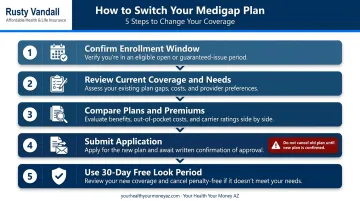
Never cancel your current plan before the new one is active. A coverage gap can cost you financially and, in some states, your right to re-enroll.
Step 5: Use the 30-Day Free Look Period, Then Cancel the Old Plan
Once your new Medigap policy arrives, you have 30 days to review it and decide whether to keep it. You'll pay premiums on both plans for any overlapping period — a small, temporary cost worth paying to avoid a coverage gap.
Only after you've decided to keep the new plan should you cancel the old one — in writing, directly with your current insurer. Get written confirmation of the cancellation.
Key Factors That Affect Your Ability to Switch
Even when you qualify for a switch, these variables can shape the outcome.
The Look-Back Period and Waiting Periods
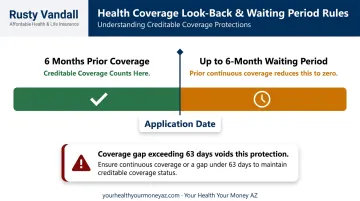
Insurers applying medical underwriting can look back 6 months before your new coverage start date. Any condition diagnosed or treated during that window may be subject to a waiting period of up to 6 months before the new plan covers it, even if your application is approved.
You can reduce or eliminate this waiting period. If you had at least 6 continuous months of creditable coverage immediately before applying — from a prior Medigap plan, employer plan, Medicare Advantage, or other qualifying coverage — that prior coverage counts toward satisfying the waiting period, reducing it to zero. Note: Breaks in coverage exceeding 63 days can void this protection.
Medical Underwriting — Conditions That Can Lead to Denial
When underwriting applies, insurers evaluate your health history and can decline applications based on specific conditions. Based on publicly available insurer underwriting guidelines, commonly deniable conditions include:
- Alzheimer's disease or dementia
- Active cancer, melanoma, leukemia, or lymphoma
- Congestive heart failure or chronic kidney/renal failure
- ESRD or dialysis
- COPD or oxygen use for lung disease
- Diabetes with complications (stroke, kidney disease, neuropathy, retinopathy)
- Need for assistance with daily activities (bathing, dressing, toileting, walking)
Some conditions don't trigger denial but lead to higher premiums. Underwriting guidelines also vary noticeably between carriers — one insurer may approve an application another declines for the same condition. Knowing which carriers are more lenient for specific conditions can make the difference between approval and denial — that's carrier-level knowledge worth having before you apply.
Under-65 Beneficiaries with Disabilities
Federal law does not require Medigap insurers to sell policies to Medicare beneficiaries under age 65. However, KFF reports that 36 states require insurers to offer at least one Medigap policy type to under-65 beneficiaries during an initial enrollment period.
Still, only 7% of traditional Medicare beneficiaries under 65 have Medigap coverage, compared to 46% of those 65 and older. That gap reflects how limited access can be outside of guaranteed issue windows. If you're under 65 with Medicare due to disability, check your state's specific rules before applying.
Common Mistakes to Avoid When Switching
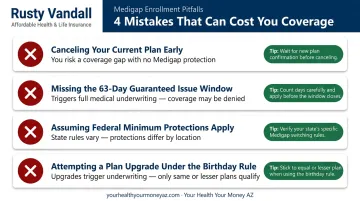
- Don't cancel your current plan before the new one is active. A coverage gap can cost you your guaranteed issue rights in some states. Always secure the new plan first.
- Missing the 63-day Guaranteed Issue window locks you into full medical underwriting. Set a calendar reminder the moment a qualifying event occurs — that window closes fast.
- Assuming your state follows federal minimums. Many beneficiaries in birthday-rule states don't know the protection exists until after the window has passed.
- Birthday and anniversary rules don't allow upgrades. These windows cover equal or lesser benefit plans only — moving from Plan N to Plan G during one still triggers medical underwriting.
What to Do If You're Denied or Can't Switch Plans
Being denied — or being outside any protected window — doesn't mean you're permanently stuck.
Stay on Your Current Plan While Waiting for the Right Window
If no protected window applies right now, identify your next opportunity. Check whether your state has a birthday rule, note your policy anniversary date, and watch for any qualifying events. A strategic switch timed to the right window is far better than an application that gets denied and potentially signals a health risk to future insurers.
Explore Medicare Advantage as an Alternative
Medicare Advantage plans cannot deny enrollment based on preexisting conditions during the Annual Enrollment Period (Oct. 15 – Dec. 7) or the Medicare Advantage Open Enrollment Period (Jan. 1 – Mar. 31). For beneficiaries who can't obtain Medigap due to health history, Medicare Advantage offers a workable alternative. The trade-off: Medicare Advantage uses provider networks, requires referrals in some plans, and may require prior authorization for certain services — a different structure than the open-access Medigap model.
Work with an Independent Medicare Specialist
An independent agent with multi-carrier access can tell you which insurers tend to be more lenient for specific conditions, whether any overlooked qualifying events apply to your situation, and which plans fit your health and budget.
Rusty Vandall at Your Health Your Money AZ works with major carriers including Aetna, Cigna, Humana, and UnitedHealthcare — comparing plan costs, coverage gaps, and network trade-offs side by side. Call 602-291-5169 or request a no-cost consultation to review your Medicare Supplement options.
Conclusion
Changing Medicare Supplement plans with preexisting conditions is possible — but it requires the right timing, an understanding of your state's rules, and a clear picture of your health history. The most common mistakes come from acting outside a protected window — or not realizing one was available in the first place.
Before making any changes to your Medigap coverage, take stock of three things:
- Your current enrollment status and how long you've held your plan
- Your state's specific protections (they vary significantly)
- Which enrollment window applies to your situation right now
Working with an independent Medicare specialist — someone who can compare options across multiple carriers, not just one — makes a real difference here. At Your Health Your Money AZ, Rusty Vandall works with clients across Arizona and multiple states to do exactly that: map out realistic options based on your health history, timeline, and budget. A well-timed switch is achievable. The key is knowing where you stand before you act.
Frequently Asked Questions
Can you change Medicare Supplement plans if you have preexisting conditions?
Yes, but timing matters. During your Medigap Open Enrollment Period or a Guaranteed Issue event, insurers must accept your application regardless of health status. Outside those windows, medical underwriting applies — meaning insurers can deny coverage or charge higher premiums based on your health history.
Is it difficult to change Medicare Supplement plans?
It depends entirely on when you're switching. During your OEP or a Guaranteed Issue window, the process is straightforward. Outside these windows, medical underwriting applies and approval isn't guaranteed — particularly if you have significant health conditions.
What is the most popular Medicare Supplement plan?
Plan G is currently the largest Medigap plan by enrollment, accounting for 39% of all Medigap policyholders — nearly 5.3 million people in 2023. Plans C and F are no longer available to those newly eligible after January 1, 2020, making Plan G the default comprehensive option for most new enrollees.
What is the Medigap Open Enrollment Period and when does it start?
The Medigap OEP is a one-time, six-month window that begins the month you turn 65 and enroll in Medicare Part B. During this window, insurers cannot deny your application, charge more due to health status, or impose most waiting periods.
Can I avoid the preexisting condition waiting period when switching Medigap plans?
Yes, if you had at least six months of continuous creditable coverage immediately before applying. That prior coverage credits against the new plan's waiting period and can reduce it to zero — but breaks in coverage exceeding 63 days can disrupt this protection.
What happens if I'm denied a Medicare Supplement plan due to my health?
A denial outside a protected window isn't permanent. You can wait for a state birthday rule window or qualifying event, switch to Medicare Advantage (which cannot deny based on health), or work with an independent agent to find carriers with more favorable underwriting for your conditions.