Introduction
Planning a babymoon, traveling for work, or visiting family while pregnant comes with an extra layer of financial uncertainty that most travelers never have to think about. What happens if you develop preeclampsia in Italy? What if an ectopic pregnancy requires emergency surgery in Thailand? A single medical evacuation can cost $20,000 to $200,000, according to the U.S. Department of State — not counting hospital bills or follow-up care.
Most pregnant travelers aren't clear on what their policy actually covers — and the gaps can be costly. Travel insurance won't pay for prenatal checkups or a planned delivery abroad. When an unexpected complication strikes mid-trip, though, the right policy can cover hospitalization, emergency transport, and trip cancellation costs that would otherwise fall entirely on you.
This guide breaks down exactly what travel insurance covers for pregnant women, which five plans stand out in 2026, and how to choose the right policy for your stage of pregnancy.
Key Takeaways
- Travel insurance covers unexpected complications like preeclampsia, miscarriage, or ectopic pregnancy — not routine prenatal care or normal childbirth
- Aim for at least $75,000 in emergency medical coverage and $500,000+ in evacuation coverage on international trips
- Top 2026 picks: Travelex Ultimate, Seven Corners Choice, Allianz OneTrip Premier, Berkshire Hathaway LuxuryCare, and Tin Leg Gold
- Buy within 14–21 days of your first trip deposit to unlock preexisting condition waivers and Cancel For Any Reason coverage
- A normal, healthy pregnancy is not classified as a preexisting condition by most travel insurers
What Does Travel Insurance Cover for Pregnant Women?
Travel insurance covers unexpected, unforeseen events — not planned or routine ones. That distinction matters more for pregnant travelers than almost anyone else.
Emergency Medical Coverage
If a pregnancy complication arises during your trip, emergency medical benefits can cover:
- Hospital stays and physician visits
- Ambulance and emergency transport costs
- Prescription medications related to the complication
- Treatment for preeclampsia, gestational diabetes, miscarriage, or ectopic pregnancy
The complication must be sudden and unforeseeable. Squaremouth's 2026 pregnancy coverage guide confirms these are the standard covered scenarios under most plans.
Medical Evacuation Coverage
This is the coverage most travelers overlook — and the most expensive gap to have. Medical evacuation pays for emergency airlift to an adequate facility or repatriation to the U.S. for treatment by your own OB/GYN.
The CDC's Travelers' Health page warns that emergency transport from a remote location to a high-quality hospital can exceed $100,000. The State Department puts the air ambulance range at $20,000–$200,000 depending on location. For a pregnant traveler in a remote destination or on a cruise, those numbers represent real exposure — not a hypothetical worst case.
Trip Cancellation and Interruption Coverage
If a covered pregnancy complication forces you to cancel before departure or cut a trip short, trip cancellation and interruption benefits reimburse prepaid, non-refundable costs.
Two caveats apply:
- A licensed physician must document that the condition prevents reasonable travel
- General morning sickness won't qualify — the complication must be diagnosed and medically significant enough that a doctor advises against traveling
Cancel For Any Reason (CFAR) Add-On
CFAR is a premium upgrade that reimburses 50–75% of prepaid trip costs if you cancel for any reason not covered by the base policy — including general discomfort, anxiety about traveling while pregnant, or discovering a new pregnancy after purchasing your policy.
The cost is real: Forbes Advisor reports CFAR adds roughly 50% to your total insurance premium, typically pushing total policy cost to 8–10% of your trip price. You must cancel at least 48 hours before departure to qualify for reimbursement. If your pregnancy is early-stage or your plans may shift based on how you're feeling, CFAR is often the most practical upgrade you can add.
Best Travel Insurance Plans for Pregnant Women in 2026
These five plans were selected based on emergency medical and evacuation limits, CFAR availability, preexisting condition waiver options, and consumer ratings. Minimum thresholds: $75,000 in emergency medical coverage, strong evacuation limits, and CFAR availability.
Travelex Insurance Services — Ultimate Plan
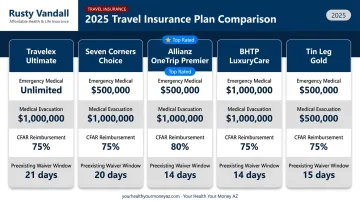
Travelex's Ultimate is the most comprehensive of its three individual trip plans and the top overall pick for pregnant travelers. It covers $250,000 in emergency medical expenses and a $1 million evacuation limit, handling worst-case scenarios with room to spare. CFAR is available as an add-on, and a preexisting condition waiver applies when purchased within 21 days of the first trip deposit.
| Benefit | Coverage |
|---|---|
| Emergency Medical | Up to $250,000 per person |
| Medical Evacuation | Up to $1,000,000 per person |
| Trip Cancellation | Up to 100% of trip costs (max $50,000); 150% for interruption (max $75,000) |
| CFAR | Up to 75% reimbursement |
| Preexisting Waiver | Purchase within 21 days of first trip deposit |
24/7 support is available via app, email, and phone.
Seven Corners — Trip Protection Choice
Seven Corners' Choice plan offers $500,000 in emergency medical coverage (among the highest available) alongside a $1 million evacuation limit and generous trip delay reimbursements. The CFAR rider reimburses up to 75% of insured costs. The preexisting condition waiver window is 20 days from initial deposit.
| Benefit | Coverage |
|---|---|
| Emergency Medical | Up to $500,000 per person |
| Medical Evacuation | Up to $1,000,000 per person |
| Trip Cancellation | Up to 100% of trip costs |
| CFAR | Up to 75% reimbursement |
| Preexisting Waiver | Purchase within 20 days of initial deposit |
24/7 emergency phone assistance included.
Allianz Travel Insurance — OneTrip Premier
Allianz explicitly covers losses from unforeseen pregnancy complications, and its documentation clarifies that a surprise pregnancy discovered after policy purchase may qualify as a covered cancellation reason. The Cancel Anytime upgrade reimburses up to 80%, the highest reimbursement rate on this list.
Emergency medical coverage is lower at $75,000, but evacuation reaches a full $1 million and trip cancellation limits top out at an exceptional $200,000.
| Benefit | Coverage |
|---|---|
| Emergency Medical | Up to $75,000 per person |
| Medical Evacuation | Up to $1,000,000 per person |
| Trip Cancellation | Up to 100% of trip costs (max $200,000); 150% for interruption (max $300,000) |
| CFAR | Up to 80% reimbursement (Cancel Anytime upgrade) |
| Preexisting Waiver | Purchase within 14 days of first trip payment |
Berkshire Hathaway Travel Protection — LuxuryCare
BHTP's LuxuryCare plan balances solid $150,000 emergency medical coverage with a $1 million evacuation limit and comprehensive cancellation protections. Its CFAR add-on reimburses only 50% of insured trip costs, lower than the other plans here. If maximum cancellation flexibility matters to you, that's a meaningful trade-off.
| Benefit | Coverage |
|---|---|
| Emergency Medical | Up to $150,000 per person |
| Medical Evacuation | Up to $1,000,000 per person |
| Trip Cancellation | Up to 100% of trip costs (max $100,000); 150% for interruption (max $150,000) |
| CFAR | Up to 50% reimbursement |
| Preexisting Waiver | Purchase within 15 days of initial trip payment |
Backed by Berkshire Hathaway Specialty Insurance, rated A++ by A.M. Best.
Tin Leg — Gold Plan
Tin Leg's Gold plan ties Seven Corners at the top for emergency medical coverage ($500,000) and earns the highest consumer rating here: 4.52 out of 5 from over 5,400 reviews on Squaremouth. Note that evacuation coverage is $500,000, not $1 million. Still strong, but worth factoring in if you're traveling to a very remote destination.
| Benefit | Coverage |
|---|---|
| Emergency Medical | Up to $500,000 per person |
| Medical Evacuation | Up to $500,000 per person |
| Trip Cancellation | Up to 100% of trip costs (max $30,000 per person) |
| CFAR | Up to 75% reimbursement |
| Preexisting Waiver | Purchase within 14 days of initial deposit |
What to Look for When Choosing Pregnancy Travel Insurance
Buy Early — This Matters More Than Most Travelers Realize
The single most important action you can take is purchasing your policy as soon as you make your first trip deposit. Both CFAR eligibility and preexisting condition waivers have tight purchase windows:
- Allianz OneTrip Premier and Tin Leg Gold: 14 days
- BHTP LuxuryCare: 15 days
- Seven Corners Choice: 20 days
- Travelex Ultimate: 21 days
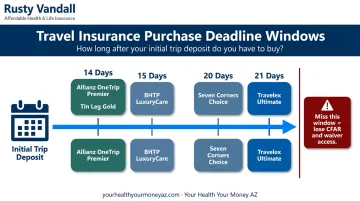
Miss those windows and you lose access to both add-ons entirely.
Minimum Coverage Benchmarks
Don't settle for a bare-bones plan. For pregnant travelers, target:
- $75,000–$100,000 minimum in emergency medical coverage (higher for remote or cruise destinations)
- $500,000 minimum in medical evacuation coverage — $1 million for international travel
- 100% reimbursement of prepaid non-refundable trip costs
- 24/7 emergency assistance with phone access
When CFAR Is Worth the Extra Cost
CFAR makes the most sense for pregnant travelers who:
- Are in the first trimester and uncertain about how the pregnancy will progress
- Discovered a pregnancy after booking and want flexibility to cancel
- Have general concerns about traveling but no diagnosed complication
- Don't want to go through the documentation process of getting a physician note for a cancellation
If any of those situations apply, the added 40–50% premium cost is likely worth it.
Compare Coverage Language, Not Just Price
Pregnancy-related coverage language varies significantly between insurers. What one policy calls a "covered complication" may be excluded by another. Working with an independent insurance professional helps you compare actual policy terms side by side across multiple carriers. Request the full policy document — not just the marketing summary — and look specifically for how each plan defines "complications of pregnancy" before you buy.
What Pregnancy Situations Are NOT Covered
Knowing the exclusions is just as important as knowing what's covered. Standard exclusions include:
- Normal childbirth — planned or unplanned delivery abroad is not covered
- Routine prenatal checkups and appointments during the trip
- General discomfort or personal hesitation to travel (without CFAR)
- Precautionary advice from a doctor when no complication has been diagnosed
The Precautionary Advice Trap
If your OB/GYN advises against travel because of a history of premature labor — but you haven't been diagnosed with any active complication — most policies will treat your pregnancy as normal and deny the cancellation claim. Policies require a formal, documented diagnosis to trigger coverage. A physician's general caution alone does not qualify.
For example: a traveler at 28 weeks with a prior preterm birth asks her doctor whether she should go. The doctor says "I'd advise against it." Without a diagnosed condition tied to this specific pregnancy, that precautionary opinion alone won't support a successful claim. CFAR would cover this situation; standard trip cancellation would not.
Airline Restrictions Are a Separate Issue
Beyond coverage gaps, airline boarding restrictions create a separate risk that many travelers overlook. Being denied boarding due to gestational age is not a covered event under travel insurance — so knowing carrier rules before you book is critical. Each major U.S. carrier has different policies:
- American Airlines: Requires a physician note within the last 48 hours for travel within 4 weeks of due date
- Delta: No restrictions or medical certificate requirements stated
- United Airlines: Medical clearance may be required at 36 weeks or for high-risk pregnancies
- Southwest Airlines: Recommends against travel beginning at week 38
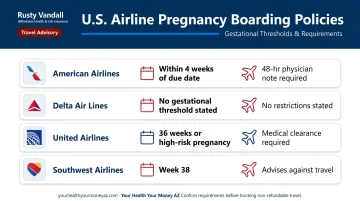
Confirm your airline's requirements before booking, and do it before insuring any non-refundable trip costs.
Conclusion
Travel insurance won't prevent a pregnancy complication from happening abroad, but it can prevent that complication from becoming a financial catastrophe. Prioritize high emergency medical and evacuation limits, add CFAR if you want genuine cancellation flexibility, and buy your policy as early as possible to keep all your coverage options open.
Once you're home, ensuring your prenatal and maternity care is covered under a solid domestic health plan matters just as much. Rusty Vandall at Your Health Your Money AZ helps individuals and families across Arizona navigate ACA health insurance options built around their specific needs. Call 602-291-5169 for a no-cost consultation.
Frequently Asked Questions
Does travel medical insurance cover pregnant women?
Yes — travel medical insurance can cover unexpected pregnancy complications like preeclampsia, ectopic pregnancy, or miscarriage that arise during a trip. Routine prenatal care and normal childbirth are excluded. Always review the specific policy language before purchasing.
Is pregnancy considered a preexisting condition for travel insurance?
A normal, healthy pregnancy is generally not classified as a preexisting condition. However, complications diagnosed before the policy purchase date — such as gestational diabetes — may be treated as preexisting, making a waiver important to secure early.
When is the best time to buy travel insurance during pregnancy?
As early as possible — ideally within 14–21 days of your first trip deposit. This window keeps preexisting condition waivers and CFAR add-on eligibility open, both valuable protections for pregnant travelers.
What is Cancel For Any Reason (CFAR) and do I need it while pregnant?
CFAR reimburses 50–80% of prepaid trip costs when you cancel for any reason not covered by the base policy. For pregnant travelers, it covers situations like general discomfort or a change of plans — scenarios standard policies won't touch.
Do I have to declare my pregnancy when buying travel insurance?
There's no requirement to declare your pregnancy at purchase. Any claim, however, will be reviewed against your medical history during the policy's lookback period — so read your coverage terms carefully before you travel.
Will travel insurance cover cancellation if my doctor advises me not to travel?
It depends. If the advice stems from a diagnosed complication — such as preeclampsia — a cancellation claim may be approved. If the advice is precautionary with no active diagnosis, most policies won't cover it. CFAR would apply in either scenario.