
Here's the problem: no insurance company currently sells short-term health insurance plans in Colorado, including Colorado Springs. This has been true since April 2019, and it catches a lot of residents off guard when they go searching.
This guide explains exactly why short-term plans disappeared from Colorado, what Colorado Springs residents can actually buy instead, and how to choose the right option for your specific situation.
Key Takeaways
- Short-term health insurance is technically legal in Colorado but no insurers offer it — the state's 2019 regulations made it commercially unviable
- Colorado Springs residents have four practical alternatives: ACA marketplace plans, COBRA, Medicaid (Health First Colorado), and health care sharing ministries (HCSMs)
- ACA plans can be purchased outside open enrollment if you qualify for a Special Enrollment Period (SEP)
- Health First Colorado (Medicaid) covers single adults earning up to $1,769/month at little or no cost
- COBRA costs roughly $793/month for single coverage, which often exceeds comparable marketplace plan premiums
What Is Short-Term Health Insurance?
Short-term health insurance is temporary, limited coverage designed to bridge gaps between major coverage periods. The tradeoff is straightforward: lower monthly premiums in exchange for far fewer covered benefits.
These plans are not regulated by the Affordable Care Act, which means they are not required to cover essential health benefits. Mental health care, maternity coverage, and prescription drugs may all be excluded. Insurers can also deny applicants based on pre-existing conditions — a protection that ACA plans must provide.
Federal Rules in 2024 and 2025
The 2024 federal rule limited short-term plans to an initial term of 3 months, with a maximum total duration (including renewals) of 4 months. That rule took effect June 17, 2024.
Then, on August 7, 2025, the Department of Labor, HHS, and Treasury announced they would not prioritize enforcement of those duration limits pending future rulemaking.
None of this matters in Colorado. State law governs what insurers can sell here, and Colorado's own rules have shut the market down regardless of what happens federally.
Is Short-Term Health Insurance Available in Colorado Springs?
No. No insurance company currently sells short-term health insurance plans in Colorado — not in Colorado Springs, not in Denver, not anywhere in the state.
Colorado's Division of Insurance enacted Regulation 4-2-59 (Concerning Premium Rate Setting for Short-Term Limited Duration Health Insurance Policies), adopted January 16, 2019 and effective April 1, 2019. The requirements it imposed were strict enough that every carrier exited the Colorado short-term market rather than comply.
Key restrictions that made the plans commercially unviable:
- Guaranteed-issue requirement — insurers cannot screen out applicants based on health history
- Mandatory coverage of ACA essential health benefits, including prescriptions and mental health care
- State-mandated benefits, including pregnancy coverage
- Minimum medical loss ratio of 80%, limiting insurer profit margins
- Age-rating cap — older enrollees cannot be charged more than three times what younger enrollees pay
- Narrow pre-existing condition definition — only conditions diagnosed, treated, or symptomatic within the prior 12 months qualify
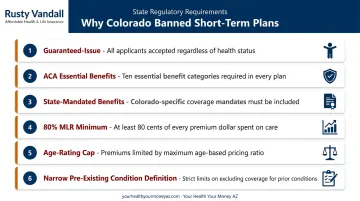
Colorado's version of a short-term plan would essentially look like an ACA plan — and without the ability to deny coverage or limit benefits, carriers saw no business case to offer one.
What This Means Practically
If you've searched for UnitedHealthcare, Pivot Health, or other national carriers offering short-term plans in Colorado Springs — those products are not available to Colorado residents. State of residence controls availability, not city. The "best short-term health insurance plan in Colorado Springs" simply isn't a product you can buy in Colorado.
The alternatives covered below often provide stronger coverage — and in some cases lower costs — than a typical short-term plan would have offered.
Best Alternatives to Short-Term Health Insurance in Colorado Springs
Each of the four options below fits a different situation. Matching your circumstances to the right option matters more than picking whichever one sounds most familiar.
ACA Plans Through Connect for Health Colorado
Connect for Health Colorado is the state's official ACA marketplace. Colorado Springs residents in El Paso County can shop plans from multiple carriers, with confirmed participation from Anthem, Cigna, and Select Health for El Paso County. (Verify current carrier availability in the Connect estimator, as participation can shift year to year.)
The flexibility most people don't know about: ACA plans don't require waiting for open enrollment if you qualify for a Special Enrollment Period. Qualifying life events include:
- Losing job-based coverage
- Turning 26 and aging off a parent's plan
- Getting married or divorced
- Having or adopting a child
- Moving to a new coverage area
Most SEPs give you 60 days from the qualifying event to enroll. That window makes ACA plans a practical coverage bridge when life changes leave you temporarily uninsured.
On cost: Income-based premium tax credits can dramatically reduce monthly premiums. Enhanced subsidies were in effect for 2025 — residents who assumed ACA plans were unaffordable should check eligibility before ruling them out. Use the KFF Health Insurance Marketplace Calculator to estimate your costs with a Colorado Springs ZIP code and your income.
COBRA Continuation Coverage
COBRA lets you keep your exact employer-sponsored plan for up to 18 months after leaving a job (some qualifying events extend this to 36 months). The catch: you pay the full premium — both your share and what your employer used to contribute — plus up to a 2% administrative fee.
The KFF 2025 Employer Health Benefits Survey puts average annual employer-sponsored premiums at $9,325 for single coverage and $26,993 for family coverage. At 102% COBRA cost, that works out to roughly $793/month single and $2,294/month family.
COBRA makes the most sense when:
- You have ongoing treatment or established provider relationships you need to maintain
- The gap before your next coverage is very short (weeks, not months)
- Your employer's plan has better benefits than what you'd find on the marketplace
For gaps longer than a month or two, an ACA plan with subsidies will often cost significantly less.
Medicaid: Health First Colorado
Health First Colorado is Colorado's Medicaid program. For single adults ages 19–65, the income eligibility threshold is up to $1,769/month (as of April 2025). Children, pregnant women, and families have separate thresholds.
If your income qualifies, check this first. Coverage typically costs nothing or very little, and it's comprehensive. Health First Colorado includes:
- No deductible and low or no premiums
- Preventive care and routine checkups
- Prescription drug coverage
- Mental health and substance use services
Check your eligibility at healthfirstcolorado.com. There's no open enrollment period — you can apply any time.
Health Care Sharing Ministries
Health care sharing ministries (organizations like Medi-Share, OneShare, and Sedera) are non-insurance arrangements where members share each other's medical costs. They're available year-round with no enrollment period, making them a direct short-term plan alternative when timing is the primary concern.
Important caveats before enrolling:
- These are not insurance and are not regulated as insurance
- They typically have waiting periods for pre-existing conditions
- Coverage varies widely — some costs may not be shared depending on the ministry's guidelines
- Colorado's DOI reports 57,358 members across 20 health care sharing arrangements in the state, so they're widely used — but consumer protections are limited compared to ACA plans
Sharing ministries work best for healthy individuals who want protection against major unexpected costs and need coverage immediately outside open enrollment. If you have ongoing prescriptions, chronic conditions, or regular provider relationships, an ACA plan will serve you better.
How to Choose the Right Coverage Option
Your situation determines your best option. Here's a quick framework:
| Your Situation | Best Starting Point |
|---|---|
| Just lost employer coverage | Compare ACA SEP plan vs. COBRA based on gap length and care continuity |
| Turning 26, aging off parent's plan | ACA SEP enrollment — you have 60 days from your birthday |
| Waiting for Medicare at 65 | ACA plan or COBRA depending on how far away your birthday is |
| Low income, below $1,769/month | Check Health First Colorado (Medicaid) first |
| Healthy, need immediate coverage outside open enrollment | Health care sharing ministry |
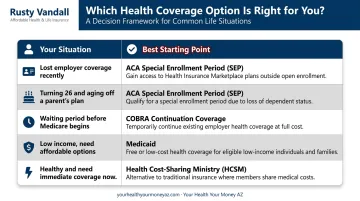
The COBRA vs. ACA decision often comes down to two questions: How long is the gap? And do you have ongoing care you need to keep without disruption? For a two-week gap, COBRA may be worth the higher cost. For three months or more, an ACA plan almost always makes more financial sense — especially with subsidies.
Working through this with a licensed independent insurance agent cuts through the confusion. Rusty Vandall at Your Health Your Money AZ specializes in ACA health insurance and helps clients compare options side by side, including SEP enrollments for people navigating coverage transitions. One client noted he "walked us through our options" and "explained every detail" when helping a dependent age off employer coverage.
To discuss your Colorado Springs coverage situation, contact Rusty at 602-291-5169 or request a no-cost consultation at yourhealthyourmoneyaz.com.
How Much Does Health Coverage Cost in Colorado Springs?
Exact premium figures for El Paso County depend on your age, household size, income, and the specific plan tier — the Connect for Health Colorado estimator and the KFF subsidy calculator are the most reliable tools for personalized numbers.
What the benchmarks tell us:
- COBRA: ~$793/month for single coverage, ~$2,294/month for family (based on KFF 2025 national averages at 102% of plan cost)
- ACA with subsidies: Often significantly lower than COBRA, especially with enhanced premium tax credits available at many income levels
- Health First Colorado (Medicaid): Free or near-free for qualifying residents earning up to $1,769/month (single adult)
For context, short-term plans in states where they're available typically run $100–$200/month nationally — but they exclude pre-existing conditions, mental health care, and preventive services. A subsidized ACA Silver plan in Colorado can reach a similar or lower monthly cost for eligible residents, with none of those coverage gaps.
To get accurate Colorado Springs premium estimates, visit the Connect for Health Colorado estimator or the KFF Health Insurance Marketplace Calculator with your ZIP code, age, and household income.
Frequently Asked Questions
Is short-term health insurance allowed in Colorado Springs?
Colorado law technically permits short-term health insurance, but no insurers have sold it in the state since April 2019. The state's regulations — including guaranteed-issue requirements and mandatory ACA benefit coverage — made the plans commercially unviable to offer.
How much does short-term health insurance cost per month in Colorado Springs?
No pricing data exists — short-term plans simply aren't sold in Colorado. The relevant comparisons are ACA marketplace plans (potentially subsidized based on income) and Health First Colorado, which may be free for residents earning up to $1,769/month as a single adult.
Are pre-existing conditions like Parkinson's disease covered by short-term health insurance in Colorado Springs?
Short-term plans aren't sold in Colorado, so this is largely hypothetical. Under Colorado law, a pre-existing condition would be defined narrowly as any condition diagnosed, treated, or symptomatic within the prior 12 months. ACA plans — the practical alternative — cover all pre-existing conditions with no exclusions or waiting periods.
What is the best short-term health insurance plan in Colorado Springs?
Since no short-term plans are sold in Colorado Springs, ACA plans through Connect for Health Colorado are the closest equivalent for most residents. Those who qualify based on income may also access Health First Colorado (Medicaid), which provides comprehensive coverage at little or no cost.
Can I buy a health care sharing plan as a short-term insurance alternative in Colorado Springs?
Yes — health care sharing ministries are available in Colorado and can be joined at any time without an enrollment period. However, they are not insurance and do not carry ACA consumer protections. They're best suited for healthy individuals seeking protection against major unexpected costs, not for anyone with ongoing medical needs.