
A Life Insurance Retirement Plan (LIRP) uses the cash value component of a permanent life insurance policy to build a tax-advantaged income stream for retirement. It's not a replacement for your 401(k) or IRA. But for the right person, it fills a gap those accounts can't.
This guide covers what LIRPs are, the three main types, who benefits most, and how to choose the right policy structure.
Key Takeaways
- A LIRP uses permanent life insurance (whole life, IUL, or VUL) to grow tax-deferred cash value you can access in retirement through policy loans
- LIRPs supplement 401(k)s and IRAs; they're most valuable after you've maxed out traditional accounts
- Policy loans from a correctly structured policy are not treated as taxable income by the IRS
- LIRPs have no IRS contribution limits (vs. the $23,500 401(k) cap and $7,000 IRA cap in 2025) and no required minimum distributions
- The earlier you start, the more cash value compounds — time horizon is everything
What Is a Life Insurance Retirement Plan (LIRP)?
A LIRP is a permanent life insurance policy — whole life, indexed universal life, or variable universal life — structured specifically to maximize cash value accumulation for retirement income. Unlike term insurance, permanent policies don't expire. Every premium payment splits between the cost of insurance coverage and a savings component that grows tax-deferred over time.
How the Retirement Function Works
In retirement, you borrow against your accumulated cash value rather than making outright withdrawals. Under IRC Section 72(e)(4)(C), loans from a non-Modified Endowment Contract life insurance policy are generally excluded from taxable income — meaning you can access those funds without triggering an income tax bill. Unlike a traditional 401(k) or IRA, where every dollar withdrawn is taxed as ordinary income, policy loans come out tax-free.
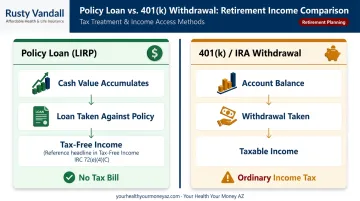
Partial withdrawals are also possible, but only up to your cost basis (total premiums paid) are tax-free. Amounts above that basis become taxable, which is why policy loans are the preferred retirement access method.
What a LIRP Is Not
LIRPs don't replace employer-sponsored plans or Social Security. For 2025, the IRS caps 401(k) employee contributions at $23,500 ($7,500 catch-up for 50+) and IRA contributions at $7,000. High earners also face Roth IRA phase-outs starting at $150,000 (single) and $236,000 (married filing jointly) in 2025. Those limits are exactly why many maxed-out savers look to LIRPs for additional tax-sheltered space.
The Overfunding Strategy
LIRPs work best when intentionally overfunded — premiums exceeding the basic cost of insurance accelerate cash value growth. The ceiling is defined by the IRS's 7-pay test under IRC Section 7702A.
Exceed it, and the policy becomes a Modified Endowment Contract (MEC), which strips away the tax-free loan advantage and adds a 10% penalty on distributions before age 59½. Staying below MEC status while contributing as much as possible is the central goal of a well-structured LIRP.
Types of Life Insurance Retirement Plans
Not all permanent life insurance is built the same. The right LIRP type depends on your risk tolerance, growth expectations, and how many years you have before retirement.
Whole Life Insurance
Whole life is the most conservative LIRP option. It offers:
- Level premiums that are guaranteed never to increase
- Cash value growth guaranteed at a fixed rate set by the insurer
- Dividend potential for policyholders of mutual insurance companies — non-guaranteed, but dividends can be reinvested to compound cash value further
The tradeoff is slower growth. A 2019 Journal of Financial Planning analysis noted that whole life cash value IRR is more comparable to bond investments than to equity returns. Whole life trades growth potential for certainty, and it suits risk-averse individuals who want a predictable, market-insulated savings component, and works best when started early enough to let slow-and-steady compounding do its work.
Indexed Universal Life (IUL) Insurance
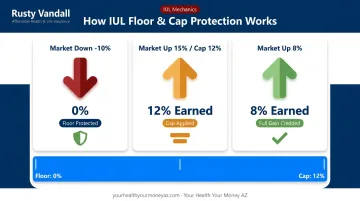
If whole life feels too conservative, IUL offers a middle ground between guaranteed growth and market participation. Cash value growth is linked to a market index (often the S&P 500) but the policy includes a floor (typically 0%) and a cap that limits upside.
Here's how that plays out in practice:
- If the index returns -10% in a given year, your cash value stays flat — you don't lose money
- If the index returns 15% but your cap is 12%, you earn 12%
- If the index returns 8% with no cap triggered, you earn 8%
IUL also offers more flexibility than whole life. Many policies let you adjust premium payments and death benefit amounts over time, which matters when income fluctuates. That adaptability makes IUL a natural fit for self-employed individuals and small business owners.
One IUL-based structure worth knowing: Maximum Premium Indexing (MPI) accounts, which are specifically designed around S&P 500-linked cash value growth for retirement income. Rusty Vandall at Your Health Your Money AZ helps clients evaluate whether MPI or standard IUL structures align with their retirement timeline.
Variable Universal Life (VUL) Insurance
VUL takes market exposure further than IUL by investing cash value directly in sub-accounts that function like mutual funds. That means stronger growth potential in bull markets, but also real downside risk — cash value can lose value. Fees are layered too: the SEC's Investor.gov lists mortality and expense risk fees, administration charges, cost of insurance, and underlying fund expenses as typical VUL costs.
VUL is subject to federal securities regulation in addition to state insurance oversight, and FINRA prohibits implying that insurer guarantees apply to the investment return or principal in the separate account. It's the least commonly recommended LIRP structure for retirement planning, suitable only for investors with high risk tolerance and a long runway ahead.
Key Benefits of a LIRP — and Drawbacks to Know
Benefits
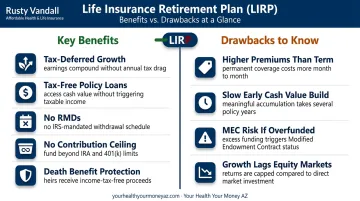
Tax-deferred growth and tax-free access Cash value grows without annual tax liability. In retirement, policy loans are generally not subject to income tax (unlike 401(k) or IRA withdrawals). LIRPs also carry no IRS-mandated Required Minimum Distributions — you're not forced to start drawing funds at age 73.
No IRS contribution ceiling (within MEC rules) According to Vanguard's 2025 How America Saves report, 49% of plan participants earning over $150,000 maxed their 401(k) contributions in 2024. For that group, a LIRP offers a meaningful additional channel to shelter income from future taxes — without a hard cap, as long as the policy stays below MEC thresholds.
Simultaneous death benefit protection A LIRP addresses two financial goals in one product. Under IRC Section 101(a)(1), death benefits paid to beneficiaries are excluded from gross income. Your retirement savings vehicle also protects your family — something a 401(k) or brokerage account can't claim.
Drawbacks
Higher cost and complexity LIRP premiums are substantially more expensive than term insurance. Cash value builds slowly in the early years as internal fees and insurance costs take their share. Missteps carry real consequences:
- Lapsed premiums can destabilize the policy's long-term structure
- Overfunding past MEC limits converts loans into taxable distributions
- Distributions before age 59½ trigger a 10% IRS penalty
Professional structuring matters — an improperly designed LIRP can erode the very tax advantages it's meant to create.
Growth typically lags market returns Whole life and IUL produce lower returns than a well-diversified equity portfolio over 20-30 years. That's the deliberate tradeoff: a LIRP prioritizes tax efficiency, downside protection, and guarantees over raw growth. Used alongside market-based investing, it fills a role that pure equity accounts can't — tax-sheltered access, guaranteed floors, and a built-in death benefit.
Who Should (and Shouldn't) Consider a LIRP
Ideal Candidates
Three profiles consistently benefit most from LIRPs:
- Maxed-out retirement savers — those who've already hit the 401(k) and IRA contribution limits and want additional tax-advantaged space
- High earners above Roth IRA thresholds — individuals whose income exceeds the 2025 phase-out ranges ($150,000 single, $236,000 married filing jointly) and want tax-free retirement income without the backdoor Roth complexity
- Self-employed individuals and small business owners — Pew Research found in 2024 that only 30% of non-traditional workers have access to workplace retirement plans, making flexible, self-directed savings vehicles especially relevant for this group
Poor Fit Scenarios
A LIRP likely doesn't make sense if:
- You haven't maxed out your 401(k) or IRA yet — those come first
- You need life insurance coverage for a defined period (a term policy is far cheaper)
- You can't commit to consistent premium payments long-term — lapses in early years can destroy cash value and trigger tax problems
- Retirement is less than 10 years away — cash value hasn't had enough time to compound meaningfully, making a LIRP a poor primary accumulation vehicle at that stage
Timing Matters
Starting earlier gives cash value more time to compound — and since premiums rise with age and declining health, waiting carries a real cost. A LIRP started at 35 and one started at 55 can be the same product from the same carrier, but the outcomes diverge sharply. Compounding simply needs time to do its work.
How to Choose the Right Life Insurance Retirement Plan
Step 1: Assess Your Full Financial Picture First
Before selecting a LIRP type, map out:
- Your current 401(k) and IRA balances and annual contribution amounts
- Your effective tax bracket now versus your expected bracket in retirement
- Your risk tolerance — specifically how you'd react to flat years (IUL) versus market losses (VUL)
- Whether a LIRP fills a real gap or duplicates coverage you already have
This prevents the most common mistake: over-relying on life insurance while underutilizing tax-advantaged accounts with employer matches or upfront deductions.
Step 2: Evaluate Policy Structure Carefully
Not all policies sold as retirement vehicles are structured to maximize cash value. A LIRP designed for retirement accumulation should have:
- Low internal costs relative to premiums paid
- Maximum cash value allocation rather than maximum death benefit
- Overfunding mechanics built in — the policy should be designed to sit just below MEC thresholds
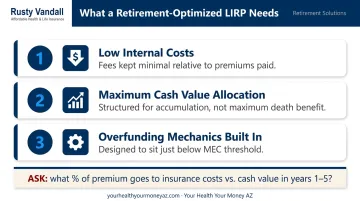
Review policy illustrations carefully. Strong projected values 20 years out can mask high early-year fees that quietly drain accumulation before it builds. Ask specifically: what percentage of your premium goes to insurance costs versus cash value in years one through five?
Step 3: Work with an Independent Agent for Carrier Comparison
LIRPs vary significantly across carriers — in pricing, cap rates (for IUL), dividend history (for whole life), and policy fee structures. Going directly to a single insurer means accepting their terms without knowing if a better-structured product exists elsewhere.
An independent agent like Rusty Vandall at Your Health Your Money AZ can compare options across multiple carriers side-by-side, matching policy structure to your specific short- and long-term retirement goals. That comparison often reveals meaningful differences in fee loads and cap rates that a single-carrier quote won't show. Reach him at 602-291-5169 to discuss whether a LIRP makes sense for your retirement picture.
Frequently Asked Questions
What is a life insurance retirement plan (LIRP)?
A LIRP is a permanent life insurance policy — whole life, IUL, or VUL — structured with an overfunded cash value component that grows tax-deferred. In retirement, policyholders access that cash value through policy loans, which are generally not subject to income tax, supplementing income from 401(k)s, IRAs, and Social Security.
Is a life insurance retirement plan worth it?
For specific profiles — high earners who've maxed traditional accounts, those above Roth IRA income limits, and self-employed individuals — a LIRP can deliver meaningful value. It requires a long time horizon and careful structuring; without both, the costs outweigh the tax advantages.
What is the most efficient retirement plan?
Most financial professionals recommend starting with employer-matched 401(k) contributions, then Roth or traditional IRAs, and only then considering supplemental tools like LIRPs. The right sequence depends on your tax situation, income level, and retirement timeline.
How much do I need to retire on $80,000 a year at 60?
Using the 25x rule — drawn from William Bengen's 1994 research on safe withdrawal rates — a target of $2,000,000 (25 × $80,000) is a reasonable starting benchmark. Retiring at 60 also means bridging a gap before Social Security eligibility (full retirement age is 67 for those born after 1960), making supplemental income sources like LIRPs especially relevant.
What are the tax advantages of a LIRP compared to a 401(k)?
A LIRP offers tax-deferred growth, income-tax-free policy loans, no required minimum distributions, and a death benefit that passes income-tax-free — advantages a 401(k) can't match. The 401(k)'s edge is the upfront tax deduction, which a LIRP doesn't provide.
What is the difference between whole life and indexed universal life insurance for retirement?
Whole life provides guaranteed, predictable cash value growth and fixed premiums — no surprises, no market exposure. IUL links growth to a market index with a 0% floor protecting against losses and a cap limiting gains. IUL offers more growth potential with moderate risk; whole life suits those who value certainty above all else.