Introduction
You've spent years building your business — the clients, the reputation, the team. But here's the question most Phoenix business owners avoid: if you died tomorrow, what happens to all of it?
Unlike W-2 employees, you have no HR department, no group benefits package, and no employer-sponsored life insurance to fall back on. Your family, your employees, and your business partners are all exposed the moment you're gone — and one death can unravel all three at once.
For Phoenix business owners, life insurance protects more than your family — it protects the business itself. This guide covers why you're especially exposed, which policy types solve which problems, and how to find the right coverage without guesswork.
Key Takeaways
- Most business owners need personal life insurance for their family and a separate policy for business continuity.
- Key person insurance, buy-sell agreements, and personal life insurance each solve a different problem.
- 59% of employer firms with debt used a personal guarantee to secure it — meaning that debt follows your family if you die.
- Working with an independent agent gives you access to multiple carriers and real comparisons.
Why Phoenix Business Owners Need Life Insurance More Than They Think
The Dual Dependency Problem
Most employees have one dependency: their family needs their paycheck. Business owners have two. Their family depends on business income, and their employees, partners, and clients depend on the owner's active involvement. Remove the owner and both collapse simultaneously.
This isn't theoretical. According to the Federal Reserve's 2026 Report on Employer Firms, 59% of employer firms with debt used a personal guarantee to secure that debt. That means when an owner dies, outstanding loans don't stay with the business — they follow the estate and, ultimately, the family.
Phoenix's Self-Employed Gap
Phoenix has a massive self-employed population with no built-in safety net. U.S. Census Bureau data shows Maricopa County had 401,448 nonemployer establishments in 2023. These are sole proprietors and independent operators with no employer-provided group coverage, no HR department managing their benefits, and no fallback if something goes wrong.
For this group, life insurance isn't a workplace benefit you opt into. It's something you build yourself or go without.
What's Actually at Risk
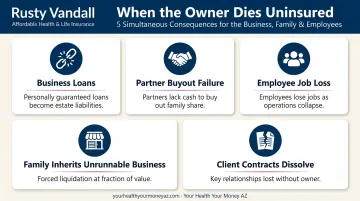
Without life insurance, a business owner's death can trigger several simultaneous crises:
- Outstanding business loans the owner personally guaranteed become estate liabilities
- Partners lack cash to buy out the deceased's family share — potentially forcing unwanted co-owners into the business
- Employees lose their jobs if the business can't operate or fund a transition
- The family inherits a business they can't run and may be forced to liquidate quickly at a fraction of its value
- Client contracts may dissolve without the key relationship holder in place
LIMRA's 2025 research found that 42% of Americans would face financial hardship within six months if a primary wage earner died. For business owners, the exposure is compounded — because the income source and the business asset can both disappear at once.
Types of Business Life Insurance Phoenix Owners Should Know
Business-specific life insurance is distinct from personal coverage and solves entirely different problems. The right policy type depends on your business structure — what a sole proprietor needs differs significantly from what a three-partner LLC requires.
Key Person Life Insurance
Key person insurance is a policy the business purchases on an owner or critical employee. The business pays the premiums and is the beneficiary. If that person dies, the death benefit gives the company financial breathing room to:
- Stabilize operations during the transition
- Cover lost revenue
- Fund recruiting and training for a replacement
- Wind down responsibly with severance for employees, if needed
Nationwide notes that lenders may also require key person insurance as a condition of financing — so it's not always optional.
Tax treatment: Key person premiums are paid with after-tax dollars and are generally not deductible. The death benefit received by the business is typically tax-free, though employer-owned life insurance contracts must meet IRS notice, consent, and exception requirements under IRC Section 101(j).
Buy-Sell Agreement Life Insurance
A buy-sell agreement is a legally binding contract between co-owners that defines what happens to a deceased owner's business share. Life insurance is the most practical way to fund it. Without it, surviving partners may not have the cash to buy out the deceased's family, which can push an unwanted outsider into the ownership structure.
Two common structures:
| Structure | Who Owns the Policy | How It Works |
|---|---|---|
| Cross-purchase | Each partner owns a policy on the other(s) | Surviving owners use proceeds to buy the deceased's equity |
| Entity purchase | The business owns all policies | The business buys back the deceased's interest |
Entity purchase is simpler to manage when there are multiple owners, since you're not tracking separate policies between every combination of partners.
Group Life Insurance
Business owners with employees can offer group life insurance as an employee benefit — it improves retention and costs less than individual coverage. Under IRS Section 79, employer-provided group-term life insurance also carries meaningful tax advantages:
- The first $50,000 of coverage is excluded from the employee's taxable income
- Employer-paid premiums are generally deductible as an ordinary business expense
- Employees receive a benefit with no out-of-pocket cost to them
For sole proprietors without employees, group life doesn't apply. But for Phoenix businesses actively hiring or trying to retain skilled workers, it's one of the more cost-efficient benefits you can add.
Personal Life Insurance: The Foundation Every Business Owner Needs
Even if a Phoenix business owner has key person coverage and a funded buy-sell agreement in place, those policies do nothing for their family. Key person insurance pays the business. Buy-sell proceeds go to the surviving partners. Neither replaces the owner's personal income, pays the mortgage, or funds a child's education.
Personal life insurance is the separate safety net the family needs — and it's non-negotiable.
Term vs. Permanent: What Most Business Owners Actually Need
| Term Life | Permanent Life | |
|---|---|---|
| Coverage period | Fixed term (10, 20, or 30 years) | Lifelong |
| Premiums | Lower, fixed during term | Substantially higher |
| Cash value | None | Builds over time |
| Best for | Income replacement during peak earning years | Complex estate planning, estate tax exposure |
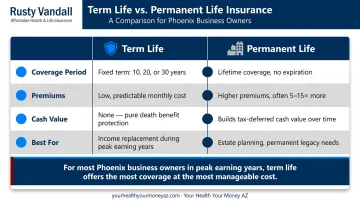
Term coverage is straightforward and designed for the years your family is most financially dependent on you. For most Phoenix sole proprietors and self-employed professionals, it's the right starting point.
Permanent life (whole life or universal life) may fit owners with estate tax exposure or those who want a cash value component to borrow against. That said, many owners end up over-complicated and underinsured by choosing permanent coverage they don't need over adequate term coverage they do.
The NAIC notes that term generally carries lower premiums in early years, while permanent is intended for lifelong coverage. For most Phoenix business owners in their peak earning years, term life provides the most coverage for the most critical window at the most manageable cost.
How Much Life Insurance Does a Phoenix Business Owner Need?
There's no universal formula, but there are useful starting points for both sides of the equation.
Personal Coverage
The common shorthand is 10–12x annual income, but that undersells what business owners actually need to account for. Guardian's current guidance uses age-based multiples — 30x income for ages 18–40, 20x for ages 41–50, and 15x for ages 51–60 — which better captures long-term income replacement needs.
For business owners specifically, also factor in:
- Business loans you personally guaranteed (these don't disappear at death)
- Whether a surviving spouse could realistically sell or continue the business
- Projected future income from a growing business, not just current revenue
Business-Specific Coverage
- Key person coverage: Multiply the key person's salary by five to seven as a baseline. Adjust upward for revenue contribution and full replacement costs — recruiting, training, and lost business during transition.
- Buy-sell coverage: Match each owner's current stake in the business. Review and update it as the business grows and its valuation changes.
Neither number is static. A business worth $500,000 today may be worth $1.5 million in five years — and an outdated buy-sell policy leaves exactly the gap it was designed to close.
Because business liabilities and personal obligations are two separate calculations, working with a licensed agent alongside a CPA or business attorney gives you the most accurate picture. Both numbers change as the business scales.
How to Get Life Insurance as a Business Owner in Phoenix, AZ
The process doesn't have to be complicated, but doing it in the right order matters.
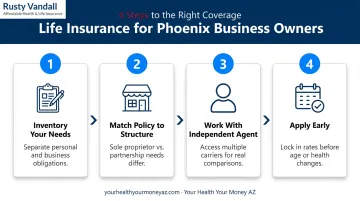
- Inventory your needs separately : list personal obligations (income replacement, mortgage, dependents) and business obligations (loans, partner buyout, key person coverage) before shopping for any policy
- Match policy types to your business structure : a sole proprietor's needs look nothing like a three-person partnership's needs; don't buy business policies designed for a structure you don't have
- Work with an independent agent : independent agents have access to multiple carriers and can run side-by-side comparisons across coverage amounts, terms, and prices; captive agents can only offer one company's products
- Apply sooner rather than later : premiums increase with age and any changes in health; locking in coverage early locks in rates that only get more expensive with time
Rusty Vandall at Your Health Your Money AZ works with Phoenix business owners across both individual and business insurance needs, with access to multiple major carriers including Banner Life. He designs plans around short- and long-term needs — not just the immediate enrollment — which matters when you're weighing personal coverage alongside supplemental business policies.
You can reach Rusty directly at 602-291-5169 or request a no-cost consultation at yourhealthyourmoneyaz.com.
The application process typically involves a health questionnaire and possibly a medical exam. Don't let that slow you down. A healthy 40-year-old can lock in competitive rates now that become significantly more expensive after a health change or a few birthdays.
Frequently Asked Questions
Can a business purchase life insurance for an owner?
Yes. Businesses regularly purchase life insurance on owners through key person insurance or as part of a buy-sell agreement. In both cases, the business is typically the policy owner and the beneficiary, with the proceeds used to stabilize operations or fund an ownership transition.
How much does a $1,000,000 life insurance policy cost per month?
According to Policygenius data from October 2024, a healthy non-smoking 40-year-old pays roughly $60–$75 per month for a $1M 20-year term policy. Rates vary based on age, health classification, and carrier — an independent agent can shop multiple carriers to find the most competitive rate for your profile.
Will life insurance pay out for cirrhosis?
It depends on timing. Policies already in force generally pay out regardless of cause of death. If cirrhosis is discovered during underwriting, however, it may result in higher premiums, coverage exclusions, or denial. Working with an experienced independent agent is critical for finding coverage if you have pre-existing health conditions.
Do I need both personal and business life insurance as a business owner?
For most business owners, yes. Personal life insurance protects your family's financial security — income, mortgage, dependents. Business policies like key person insurance and buy-sell coverage protect the company's continuity. Each serves a distinct purpose, and most owners need both in place.
Is life insurance tax-deductible for business owners in Arizona?
Generally, no — premiums are not deductible when the business or owner holds a financial interest in the policy. The exception is employer-paid group term life insurance up to $50,000 per employee, which may be deductible under federal rules (Arizona uses federal AGI as its tax starting point). Consult a tax advisor for your specific situation.
What happens to my business if I die without life insurance?
Without coverage, the consequences can be severe:
- Forced liquidation to settle personally guaranteed debts
- Partners lacking cash to buy out your family's share
- Employees losing their jobs as operations collapse
- Your family inheriting a business they can't run — and facing pressure to sell it at a fraction of its actual value