
That's where a Life Insurance Retirement Plan (LIRP) comes in. More pre-retirees are exploring this strategy to build an additional layer of tax-advantaged income — one that carries no IRS contribution caps, no required minimum distributions, and a death benefit their family actually receives.
This guide covers everything you need to know: what a LIRP is, how it works, the tax advantages, which policy types qualify, and how to determine whether it fits your situation.
Key Takeaways
- A LIRP uses the cash value inside a permanent life insurance policy as a supplemental retirement savings vehicle
- LIRPs complement 401(k)s and IRAs — they don't replace them; fund traditional accounts first
- Policy types include whole life, universal life, indexed universal life (IUL), and variable universal life (VUL) — each with different risk and growth profiles
- Key advantages include no IRS contribution limits, no required minimum distributions (RMDs), and tax-free policy loans
What Is a Life Insurance Retirement Plan (LIRP)?
A LIRP is a strategy where you deliberately overfund a permanent life insurance policy to accelerate the growth of its cash value, then draw on that cash value as supplemental income in retirement. The IRS doesn't recognize it as a distinct account type — it's a deliberate approach to using a policy's built-in features for retirement planning.
As Charles Schwab describes it, a LIRP involves paying more than the minimum required premium into a permanent policy to build up usable cash value over time.
Term vs. Permanent Life Insurance
This distinction matters: only permanent life insurance policies can function as a LIRP. Term policies provide coverage for a set period with no cash value component. Permanent policies — whole life, universal life, IUL, and VUL — accumulate cash value that you can actually access.
The LIRP strategy works because permanent policies carry two components simultaneously:
- A death benefit that protects your family
- A cash value account that grows tax-deferred and can be tapped in retirement
Because both components operate within the same policy, the cash value builds alongside your coverage — which is what makes a LIRP useful as a supplemental retirement tool. That said, it's not a foundation. Max out your 401(k) and IRA first, then consider a LIRP for additional tax-advantaged savings on top of those accounts.
How Does a LIRP Work?
Every premium payment you make gets divided. One portion covers the cost of insurance (the death benefit). The rest flows into your cash value account, where it compounds on a tax-deferred basis. Deliberately overfunding the policy — beyond the base premium — is what drives that growth.
Overfunding and the Section 7702 Limit
LIRPs are funded above the minimum premium. This "overfunding" accelerates cash value growth — but there's a boundary. IRC Section 7702 sets the tax qualification tests for life insurance. Exceed the funding limits under IRC Section 7702A — specifically the "7-pay test" — and the policy becomes a Modified Endowment Contract (MEC). MECs lose favorable tax treatment: loans and withdrawals become taxable distributions subject to a 10% penalty before age 59½.
Keeping funding below MEC limits preserves the tax-free loan and withdrawal treatment that makes a LIRP worth using in the first place.
Accessing Your Cash Value
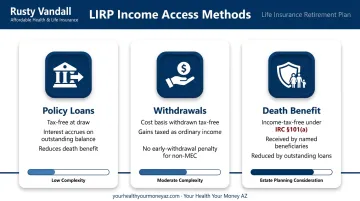
When it's time to draw income, a LIRP gives you three distinct access methods — each with different tax and risk profiles:
Policy Loans
- Borrow against your cash value at any age, no income taxes triggered at the time of the loan
- Interest accrues on outstanding balances
- Unpaid loans reduce the death benefit paid to beneficiaries
- If the policy lapses with an outstanding loan, the loan amount above your cost basis becomes ordinary taxable income — this is the most serious risk in a LIRP
Withdrawals
- Withdraw up to your total premiums paid (your "cost basis") completely tax-free
- Amounts above the cost basis are taxed as ordinary income
- No 10% early withdrawal penalty for non-MEC policies, even before age 59½ — unlike a 401(k) early withdrawal
Death Benefit
- IRC Section 101(a) excludes life insurance death benefits paid to beneficiaries from federal income tax
- Outstanding loans and prior withdrawals reduce the benefit amount
Types of Life Insurance Policies Used in LIRPs
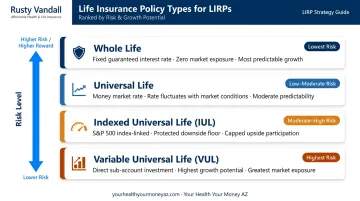
Not all permanent policies serve the same purpose. Your risk tolerance and growth expectations should drive which type you choose.
Whole Life Insurance
The most conservative LIRP option. Cash value grows at a fixed, guaranteed rate set by the insurer — no market exposure, no surprises. Participating whole life policies can also earn annual dividends based on the insurer's performance, which can be reinvested to compound cash value further.
Best for: risk-averse individuals who prioritize guarantees over growth potential.
Universal Life Insurance
More flexible than whole life, with adjustable premiums and death benefit amounts. Cash value earns interest based on current money market rates, so returns fluctuate with market conditions.
Universal life comes in three subtypes — standard, indexed, and variable — each with a different risk-return profile.
Indexed Universal Life (IUL)
IUL links cash value growth to a stock market index like the S&P 500, but with guardrails:
- A floor (typically 0%) protects against losses when the index drops
- A cap limits maximum gains in strong market years
- No direct investment in the market — growth is credited based on index performance
That combination of downside protection and upside participation makes IUL the most common LIRP structure in use today. Rusty Vandall at Your Health Your Money AZ works with IUL-based strategies, including MPI (Maximum Premium Indexing) accounts, which use cash value drawdowns to generate retirement income.
Variable Universal Life (VUL)
VUL allows you to invest cash value directly in sub-accounts similar to mutual funds. The upside: highest growth potential of any permanent policy. The downside: cash value can decrease if investments perform poorly.
Because VUL invests in securities, agents selling these policies must hold both a state insurance license and a FINRA securities registration — a requirement that doesn't apply to other policy types.
Key Tax Advantages of a LIRP
| Advantage | How It Works |
|---|---|
| Tax-deferred growth | Cash value compounds without annual tax liability, unlike a standard brokerage account |
| Tax-free loans | Policy loans aren't classified as income by the IRS, so no taxes owed when you borrow |
| Tax-free death benefit | Under IRC §101(a), beneficiaries receive the death benefit free of federal income tax |
| No RMDs | The IRS does not include life insurance policies in its RMD-required account list |
The no-RMD rule stands out for retirees managing tax exposure. Traditional IRAs and 401(k)s require taxable distributions starting at age 73 — or age 75 if you were born in 1960 or later, per IRS Publication 590-B. Those forced withdrawals increase your taxable income each year, sometimes pushing you into a higher bracket or triggering higher Medicare premiums. A LIRP carries no such requirement. You decide when and how much to access, giving you direct control over your taxable income in retirement.
LIRP vs. 401(k) vs. IRA: How They Compare
| Feature | LIRP | 401(k) | Traditional/Roth IRA |
|---|---|---|---|
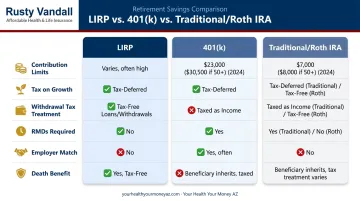
| 2026 Contribution Limit | No fixed IRS cap (Section 7702 limits apply) | $24,500 employee deferral ($8,000 catch-up age 50+) | $7,500 total ($1,100 additional catch-up age 50+) |
| Tax on Growth | Tax-deferred | Tax-deferred | Tax-deferred (Traditional) / Tax-free (Roth) |
| Withdrawals | Tax-free loans; cost basis tax-free | Taxed as ordinary income | Roth: tax-free; Traditional: taxed as income |
| RMDs Required | No | Yes, starting at age 73–75 | Roth: no (owner); Traditional: yes |
| Employer Match | No | Yes (if employer offers) | No |
| Income Eligibility Restrictions | None | None | Roth IRA phased out at $153,000–$168,000 (single) / $242,000–$252,000 (married filing jointly) for 2026 |
| Death Benefit | Yes, income-tax-free | No | No |
One comparison stands out: both a Roth IRA and a LIRP deliver tax-free income in retirement, but Roth IRAs cut off at income thresholds. High earners phased out of Roth contributions face no equivalent restriction with a LIRP — making it a practical alternative for that income bracket.
Who Should Consider a LIRP?
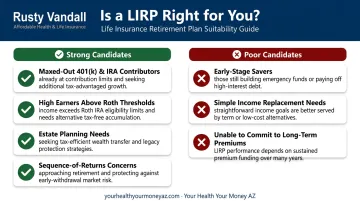
A LIRP makes the most sense in specific situations. It's not a universal fit.
Strong Candidates
- Maxed-out contributors: You've already hit the annual 401(k) and IRA limits and need another tax-advantaged vehicle
- High earners: Your income exceeds Roth IRA eligibility thresholds (thresholds that adjust annually — check current IRS limits), making a LIRP one of the few remaining tax-free income options available
- Estate planning needs: You want to leave a tax-free inheritance to beneficiaries without the complexity of trust structures
- Sequence-of-returns concerns: Retirees who want a cash value bucket to draw from during market downturns, avoiding forced asset sales at a loss in early retirement years
Poor Candidates
- People just starting retirement savings who haven't yet maxed traditional accounts
- Those who need straightforward income replacement insurance — term life is far more cost-efficient for that purpose
- Anyone who can't commit to long-term premium payments; early surrender typically results in meaningful financial losses
The Value of Working with an Independent Agent
LIRPs must be structured carefully. Overfunding levels, policy type selection, and loan strategy all affect whether the plan performs as intended. Get any of those wrong and you may face an unexpected tax bill.
Rusty Vandall at Your Health Your Money AZ treats LIRP planning as one piece of a broader retirement conversation — reviewing your full financial picture before recommending a structure. As an independent agent working with carriers including Banner Life and others, he's not locked into a single company's product lineup. That means the comparison spans the actual market. Reach him directly at 602-291-5169 or request a no-cost consultation to explore whether a LIRP fits your retirement picture.
Frequently Asked Questions
How does a LIRP compare to a 401(k)?
A 401(k) offers employer matching, higher investment return potential, and straightforward tax deferral, but comes with annual contribution limits and mandatory RMDs starting at age 73–75. A LIRP has no contribution caps or RMDs and provides a tax-free death benefit, but lacks employer matching. The two work best together rather than as alternatives.
Is a LIRP taxable?
Cash value grows tax-deferred, loans against it aren't taxable income, and withdrawals up to your cost basis are tax-free. The death benefit is income-tax-free to beneficiaries under IRC §101(a). Withdrawals above the cost basis — or a lapsed policy with outstanding loans — can trigger ordinary income taxes.
What happens if a LIRP policy lapses?
A lapsed policy means you lose the death benefit and may owe ordinary income tax on any gains or outstanding loan balances in the year of lapse. This is the most serious risk in a LIRP and the primary reason proper structuring and consistent premium payments matter.
Can I have both a LIRP and a 401(k) or IRA?
Yes — and most financial professionals recommend it. The typical sequence is to fund your 401(k) enough to capture any employer match, max out IRA contributions, then consider a LIRP as an additional tax-advantaged layer on top of those accounts.
How much does a life insurance retirement plan cost?
Premiums vary based on age, health, policy type, death benefit size, and any riders. Because LIRPs are overfunded to maximize cash value, costs run significantly higher than standard permanent policies. A 40-year-old female might pay roughly $340 annually for a 20-year term policy versus around $4,968 per year for a comparable whole life policy, according to Kiplinger's analysis.
What is the difference between a LIRP and a Roth IRA?
Both deliver tax-free retirement income, but a Roth IRA has annual contribution limits and income-based eligibility restrictions that block high earners from contributing directly. A LIRP has no income limits, no fixed contribution cap, and includes a death benefit. Roth IRAs typically offer broader investment options and stronger long-term growth potential for those who qualify.